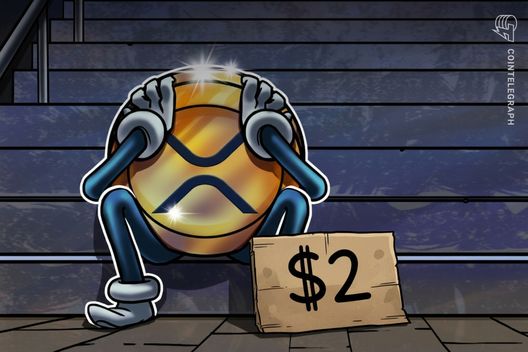
In the often-counterintuitive world of cryptocurrency, recent price action for XRP has presented a compelling paradox for investors and analysts alike. Despite a demonstrable surge in demand for spot crypto ETFs and robust network activity on the XRP Ledger, the digital asset found its price slipping below the critical $2 mark amidst a broader market sell-off. This scenario underscores a fundamental truth in financial markets: even the strongest individual fundamentals can temporarily succumb to overwhelming macro sentiment and fear, forcing a reevaluation of what truly drives value in the short versus long term.
From a senior crypto analyst’s perspective, this divergence between intrinsic strength and immediate price performance is not merely a data point but a crucial learning moment. The narrative for XRP, post-partial resolution of its long-standing legal battle with the SEC, has been one of rekindled optimism. Institutional interest, often catalyzed by the advent of accessible investment vehicles like spot ETFs for major cryptocurrencies, typically signals a maturing market and increased liquidity. When the source context highlights ‘strong spot ETF inflows,’ it speaks to a broader institutional appetite for crypto exposure, an appetite that, in theory, should naturally extend to established assets like XRP.
Indeed, the anticipation and reality of spot Bitcoin and Ethereum ETFs have been game-changers, opening floodgates for capital from traditional finance. While a dedicated XRP spot ETF is not yet a reality in major markets like the U.S., the general sentiment of institutional acceptance stemming from other crypto ETF successes often creates a rising tide that lifts all compliant boats. The ‘demand’ mentioned could reflect this spillover effect or even speculative interest in future XRP ETPs in compliant jurisdictions. Such demand, by conventional wisdom, should act as a strong bullish catalyst, signaling increasing legitimization and easier access for a wider investor base.
Adding to this bullish undercurrent is the ‘robust network’ performance of the XRP Ledger (XRPL). A surge in transactions on any blockchain network is a powerful indicator of utility and adoption. The XRPL is designed for speed, low cost, and scalability, making it a preferred choice for payment solutions, remittances, and increasingly, for decentralized finance (DeFi) applications and tokenization projects. High transaction volume signifies real-world use cases, a bustling ecosystem, and fundamental value being generated. In a mature market, this kind of operational strength is a primary driver of valuation, suggesting a healthy, actively used, and growing platform.
Yet, despite these potent positive signals, XRP’s price dipped. The culprit, as identified by the source context, was a ‘market-wide sell-off.’ This phrase, often used to encapsulate a cascade of profit-taking, risk aversion, or liquidation events across the entire crypto ecosystem, illustrates the powerful gravitational pull of collective sentiment. In such environments, even assets with stellar individual performance metrics can be dragged down. Factors contributing to a market-wide sell-off can range from macroeconomic concerns (inflation fears, interest rate hikes), regulatory uncertainty (though less specific to XRP now, general crypto regulatory FUD can affect sentiment), or simply large-scale profit-taking after significant rallies in other leading assets.
What this incident highlights is the inherent immaturity and interconnectedness of the crypto market. While individual assets like XRP strive for independent valuations based on their utility and adoption, they remain highly correlated, especially to Bitcoin’s price movements. When Bitcoin faces downward pressure, altcoins often experience amplified dips as investors de-risk across the board. The ‘investor sentiment failed to lift’ aspect points to this overarching fear; the positive news, while fundamentally sound, was simply not strong enough to counteract the prevailing bearish mood.
For investors, this presents a critical juncture for reflection. Is the current price dip an indicator of weakening fundamentals, or merely a temporary blip caused by external market forces? A senior analyst would argue for the latter in this specific instance. The underlying strength of XRP — its network utility and burgeoning institutional interest — remains intact. The dip is more a reflection of market psychology and the cyclical nature of corrections rather than a flaw in XRP’s long-term value proposition.
This episode serves as a powerful reminder of several investment tenets: the importance of distinguishing between short-term price volatility and long-term value accrual, the pervasive influence of macro market trends, and the psychological impact of fear during sell-offs. For those bullish on XRP’s vision and technological prowess, periods like these, where price diverges from strong fundamentals, are often viewed as potential accumulation opportunities, provided one has a high conviction in the asset’s future trajectory and utility. However, it also underscores the need for robust risk management and a diversified portfolio, as even assets with promising prospects are not immune to broader market tides.
In conclusion, XRP’s recent struggle to maintain its price despite strong tailwinds is a classic case study of market dynamics overriding individual asset strength. While challenging for short-term holders, it reinforces the enduring value proposition of network utility and institutional legitimization for the long-term health of any digital asset. The current market action is a test of conviction, separating those who react to daily fluctuations from those who invest in fundamental growth and future potential.