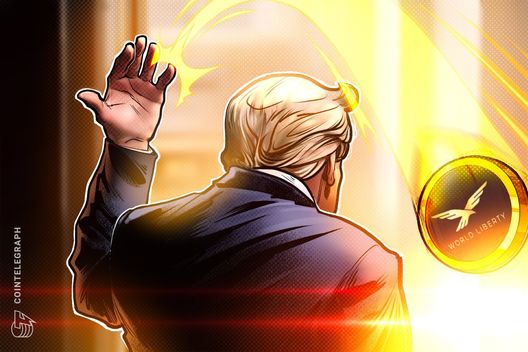
The cryptocurrency market, still reeling from past cataclysms, finds itself once again gripping its collective breath as World Liberty Financial (WLFI) faces grave ‘LUNA 2.0’ allegations. Reports indicate that WLFI’s native token, WLFI, may plunge by as much as 20% in the immediate aftermath, signaling a rapid erosion of investor confidence. The core of the controversy centers on claims that World Liberty Financial allegedly utilized illiquid tokens as collateral to secure a substantial $75 million loan, sparking widespread fears of systemic bad debt and drawing chilling parallels to the Terra-LUNA collapse.
For seasoned crypto participants, the phrase ‘LUNA 2.0’ evokes a visceral memory of marketwide panic, billions in lost capital, and a stark lesson in the fragility of poorly structured financial mechanisms. Terra-LUNA’s demise stemmed from the de-pegging of its algorithmic stablecoin, UST, and the subsequent hyperinflation of its native LUNA token, which was meant to back UST’s value. The critical failure point was the reliance on an internally generated, ultimately unbacked asset (LUNA) to provide stability, creating a death spiral when confidence faltered. While the specifics of the WLFI allegations differ – focusing on illiquid collateral for a loan rather than an algorithmic stablecoin – the underlying systemic risk mirrors LUNA’s fundamental flaw: the potential for a house of cards built on assets whose true market value and liquidity are questionable.
The alleged use of ‘illiquid tokens’ as collateral for a $75 million loan is a critical red flag. Illiquid tokens are characterized by low trading volume, wide bid-ask spreads, and significant price impact from even small transactions. Their market depth is shallow, meaning that attempts to sell a substantial amount quickly would likely crash their price. When such tokens are used as collateral for a large loan, the perceived value of the collateral can be wildly disconnected from its realizable value in a stressed market. Should the value of these illiquid tokens dip even slightly, or should lenders demand repayment, WLFI could find itself severely under-collateralized. This scenario would trigger margin calls that WLFI might be unable to meet without liquidating other assets or attempting to sell the very illiquid tokens, thereby exacerbating the price crash and pushing the project into a death spiral similar to LUNA’s.
The immediate market reaction, with WLFI’s token potentially dropping 20%, is a testament to the acute fear gripping traders. This isn’t just a localized dip; it represents a significant loss of trust in the platform’s financial integrity and risk management. The fear isn’t solely confined to WLFI holders; it spills over into the broader market as investors question the transparency and solvency of other projects, particularly those involved in decentralized finance (DeFi) lending and borrowing where collateral quality can sometimes be opaque. The potential for ‘bad debt’ is particularly concerning, as it implies that lenders who extended the $75 million loan might face significant losses if WLFI defaults, potentially creating a contagion effect across various crypto protocols and institutions.
From a senior crypto analyst’s perspective, these allegations underscore recurring vulnerabilities within the digital asset ecosystem. The demand for yield and leverage often leads platforms to take on increasingly risky positions, sometimes backing substantial loans with assets that lack true market depth or independent valuation. Such practices are antithetical to sound financial principles and invite regulatory scrutiny, which the crypto industry is already facing in spades. The lessons from Celsius, FTX, and, most prominently, Terra-LUNA, emphasized the dire consequences of insufficient transparency, poor risk management, and the use of proprietary or illiquid assets as primary collateral or backing.
For World Liberty Financial, addressing these allegations requires immediate and comprehensive transparency. The platform must provide irrefutable evidence regarding the nature, liquidity, and true market value of the tokens used as collateral. Independent audits, public disclosures of balance sheets, and a clear explanation of their lending and risk management policies are paramount to restoring any semblance of confidence. Without such measures, the shadow of ‘LUNA 2.0’ will continue to loom large, pushing WLFI towards potential insolvency and further eroding the already fragile trust in the wider crypto market.
Investors, meanwhile, should treat this situation as a stark reminder of the paramount importance of due diligence. Diversification, understanding the underlying mechanics and collateral quality of any platform one interacts with, and exercising extreme caution with projects promising outsized returns backed by opaque assets are critical. The crypto market’s journey towards maturity is paved with the failures of projects that disregarded fundamental financial prudence. The WLFI allegations serve as yet another, unwelcome, chapter in this ongoing narrative, highlighting that while the technology may be innovative, the oldest financial risks remain persistently relevant.