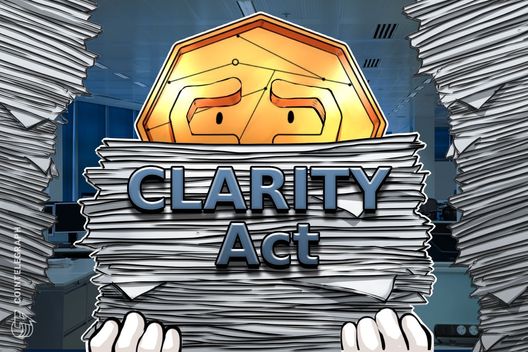
The often tumultuous journey toward comprehensive cryptocurrency regulation in the United States recently received a shot of optimism, sending ripples through the digital asset market. US Senator Bernie Moreno’s recent comments, stating the US CLARITY Act could pass ‘hopefully by April,’ prompted a significant surge in prediction market Polymarket, where odds of the bill’s passage by 2026 briefly spiked to a remarkable 90%. While this renewed hope is palpable, a senior crypto analyst must dissect the implications, the reality, and the considerable challenges still ahead.
**The Quest for Clarity: What the CLARITY Act Promises**
The US crypto industry has long suffered from a patchwork, often contradictory, regulatory environment. The lack of clear definitions for digital assets, the jurisdictional tug-of-war between the Securities and Exchange Commission (SEC) and the Commodity Futures Trading Commission (CFTC), and a ‘regulation by enforcement’ approach have stifled innovation, driven talent offshore, and deterred institutional capital. This is where the CLARITY Act, by its very name, aims to intervene.
While specific legislative text is still under wraps for public scrutiny, the widely anticipated purpose of the CLARITY Act is to establish a foundational framework for digital asset regulation. This likely includes clear definitions for what constitutes a security, a commodity, or a novel asset class in the crypto space. It would aim to delineate the responsibilities of the SEC and CFTC, provide guidelines for stablecoins, and perhaps even address aspects of decentralized finance (DeFi) and NFTs. Such a framework is not just about compliance; it’s about providing the certainty required for businesses to innovate, investors to participate with confidence, and institutions to deploy capital without fear of retrospective enforcement actions.
**Senator Moreno’s Catalyst and Polymarket’s Pulse**
Senator Bernie Moreno, a Republican from Ohio and a relatively new face in the Senate, has quickly emerged as a vocal proponent of clear crypto regulation and a champion for innovation. His optimistic declaration of a potential ‘April’ passage has injected a rare dose of urgency and confidence into the long-stalled legislative process. Moreno’s comments are significant because they suggest active engagement and a perceived path forward, rather than the usual political gridlock.
The immediate reaction on Polymarket, a decentralized prediction market, underscores the market’s hunger for such news. The ‘odds of passing in 2026’ contract jumping to 90% is a powerful indicator of collective sentiment. Prediction markets, while speculative, often aggregate diverse information and can reflect perceived probabilities more accurately than traditional polls. The spike suggests that market participants, absorbing Moreno’s insights, now see a much higher likelihood of substantial regulatory action in the near term, or at least within the next two years.
**Implications for the Crypto Ecosystem**
Should the CLARITY Act pass, its positive ramifications could be profound:
1. **Institutional Influx**: Regulatory certainty is the golden key for institutional investors. Clear rules of the road would likely unlock significant capital from traditional finance, accelerating mainstream adoption of cryptocurrencies and blockchain technology.
2. **Innovation and Competitiveness**: With defined boundaries, developers and entrepreneurs can build confidently, fostering a more robust and competitive US-based crypto industry. This could reverse the trend of companies relocating to more crypto-friendly jurisdictions.
3. **Investor Protection**: A clear framework would likely include enhanced disclosures, operational standards for exchanges, and robust consumer protections, mitigating risks associated with scams and market manipulation.
4. **Market Maturation**: Reduced uncertainty and a more stable environment could lead to less volatility, allowing digital assets to be valued more on fundamental utility than on regulatory speculation.
**Navigating the Road Ahead: Challenges and Caveats**
Despite the recent surge in optimism, the path to legislative enactment is fraught with challenges. Senator Moreno’s ‘hopefully by April’ is a wish, not a guarantee. Here’s why:
1. **Political Landscape**: Bipartisan consensus is notoriously difficult to achieve in the current political climate, especially on novel and complex issues like crypto. Different factions within both parties hold varying views on the extent and nature of regulation.
2. **Defining ‘Clarity’**: The devil is in the details. The specific definitions and jurisdictional lines drawn in the Act will face intense lobbying from various industry players and regulatory bodies, each vying for favorable outcomes. What constitutes ‘clarity’ for one entity might be seen as overreach by another.
3. **Regulatory Resistance**: Agencies like the SEC, under Chairman Gensler, have historically favored a broad interpretation of existing securities laws to regulate crypto. Any new legislation that curtails their authority could face resistance, potentially leading to legislative battles or prolonged implementation.
4. **Timeline Realities**: The legislative process is often slow and cumbersome, involving committee hearings, markups, floor votes in both chambers, and reconciliation of differing versions. An April passage, while ideal, would be an exceptionally rapid turnaround for such a comprehensive and impactful bill.
**Conclusion: Cautious Optimism Prevails**
Senator Moreno’s optimistic comments have undoubtedly breathed new life into the perennial hope for regulatory clarity in the US crypto market. The Polymarket spike is a testament to the market’s eagerness for progress. As a Senior Crypto Analyst, I view this development with cautious optimism. While the ‘hopefully by April’ timeline seems aggressive given the inherent complexities of Washington, the very discussion and the growing bipartisan recognition of the need for a comprehensive framework are positive signals. The CLARITY Act, if successfully passed and implemented thoughtfully, has the potential to reshape the US as a leading hub for digital asset innovation and investment. However, stakeholders must remain vigilant, monitoring legislative developments, lobbying efforts, and the ever-present political headwinds that could either propel this bill forward or consign it to further delays. The coming months will be crucial in determining whether this beacon of hope turns into a concrete regulatory framework or remains a distant mirage.