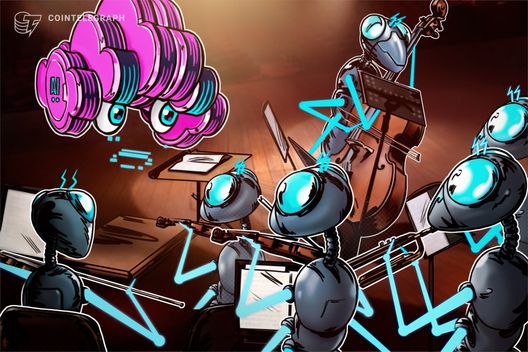
The creative landscape is undergoing a seismic shift, driven by the accelerating capabilities of Artificial Intelligence. Music, an art form deeply rooted in human emotion and intellectual property, is at the forefront of this revolution. AI-powered tools are now capable of generating melodies, harmonies, lyrics, and even entire compositions with astounding fidelity and speed. While this democratizes creation and offers unprecedented avenues for artistic expression, it simultaneously exposes critical fault lines in traditional music licensing, ownership, and royalty distribution systems. As a Senior Crypto Analyst, it’s clear that these growing pains necessitate a foundational, immutable infrastructure: blockchain technology.
The promise of AI music is immense. Artists can augment their creative process, generate variations, or even craft bespoke soundtracks for various media. The sheer volume of potential new content is staggering, leading to an explosion of derivative works, remixes, and micro-samples. However, this proliferation immediately clashes with existing frameworks. Who owns the AI’s output? Is it the artist who prompted it, the developer who built the algorithm, or the myriad artists whose data trained the model? How are royalties distributed when an AI generates a thousand remixes of a single track, each with fractional contributions from various sources? The current system, characterized by opaque intermediaries, slow payment cycles, and complex international legal battles, simply isn’t equipped for this scale and complexity.
Traditional music licensing is a labyrinthine process involving collection societies, publishers, PROs (Performing Rights Organizations), and a myriad of contracts. When an AI enters the equation, creating, remixing, and potentially iterating at speeds impossible for humans, this system breaks down. Attribution becomes a nightmare, leading to disputes over ownership and compensation. Creators risk being exploited, or worse, having their work absorbed into vast datasets without proper credit or recompense. The fundamental issue lies in the lack of a transparent, universally recognized, and automated mechanism for tracking provenance, defining ownership, and ensuring fractional royalty distribution across a fragmented, globally-distributed creator base.
This is precisely where blockchain technology emerges not merely as an option, but as an architectural imperative. At its core, blockchain offers an immutable, distributed ledger that can record every single transaction and piece of data in an unalterable, time-stamped sequence. For AI music, this translates into several transformative capabilities:
1. **Immutable Provenance and Attribution:** Every original composition, every AI model used, every prompt, every derivative work, and every remix can be digitally fingerprinted and registered on a blockchain. This creates an undeniable, transparent historical record of creation and contribution. Non-Fungible Tokens (NFTs) can represent unique ownership of individual tracks, elements, or even AI models themselves, providing verifiable proof of authenticity and ownership in a world teeming with AI-generated content.
2. **Automated Smart Contract Royalties and Licensing:** This is perhaps the most revolutionary aspect. Smart contracts are self-executing agreements whose terms are directly written into code. For AI music, a smart contract can be programmed to automatically distribute royalties in real-time, based on predefined rules, to all contributing parties. Imagine a track being streamed: a micro-payment is instantly split among the primary artist, the AI model developer, the sound engineer, and even artists whose work contributed to the AI’s training data – all without the need for intermediaries or lengthy accounting reconciliation. This guarantees fairness, eliminates delays, and drastically reduces administrative overhead.
3. **Tokenization and Fractional Ownership:** Beyond NFTs for unique works, blockchain enables the tokenization of music rights into fungible tokens. This opens up entirely new economic models, allowing creators to fractionalize ownership of their intellectual property, enabling fans, investors, or collaborators to directly participate in the success of a track. This moves beyond traditional artist-label models, fostering a more direct, community-driven economy around music creation.
4. **Transparency and Auditability:** Every transaction, every royalty distribution, and every license agreement recorded on the blockchain is publicly verifiable (while respecting privacy controls where necessary). This eliminates the ‘black box’ problem of traditional royalty statements, fostering trust and accountability across the entire ecosystem. Creators can see exactly when and how their work is being used and compensated.
While the advantages are clear, implementing such a system is not without its challenges. Legal frameworks worldwide need to adapt rapidly to define AI-generated intellectual property rights. Interoperability between different blockchain networks will be crucial to avoid siloed ecosystems. Furthermore, the scalability of underlying blockchain technology needs to continue advancing to handle the potentially astronomical volume of micro-transactions generated by a thriving AI music economy. User adoption and education within the broader music industry will also be key to successful integration.
In conclusion, the intersection of AI and music represents a new frontier of creativity and commerce. However, for this frontier to be equitable and sustainable, it demands an infrastructure built for transparency, automation, and immutable record-keeping. Blockchain technology, with its capacity for smart contracts, verifiable provenance, and decentralized distribution, offers precisely this. It’s not just about managing complexity; it’s about empowering creators, ensuring fair compensation at an unprecedented scale, and fostering an innovative, trustless environment where the harmony of algorithms truly serves the artists and their audience. The future of AI music doesn’t just need blockchain; it intrinsically depends on it to hit the right notes for all involved.