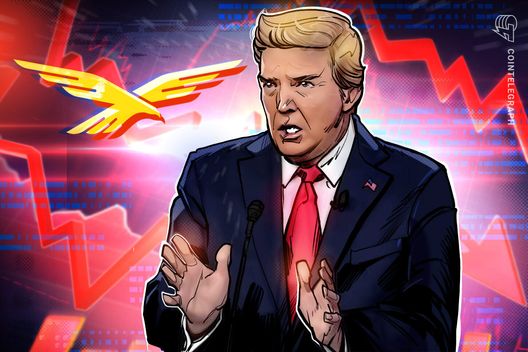
The crypto market, ever a crucible of innovation and speculation, is currently grappling with the alarming decline of WLFI, a token notably associated with former President Donald Trump. WLFI recently plummeted to a record low, not merely due to broad market movements, but following a revelation that has sent tremors through investor confidence: the project utilized billions of its native tokens as collateral to secure a substantial $75 million stablecoin loan. This move, while perhaps intended to inject liquidity or fund development, has instead ignited a firestorm of concern, exposing critical vulnerabilities in the project’s financial architecture and raising profound questions about its long-term viability and the broader implications for tokenomics and investor protection.
At the heart of the controversy lies the highly unconventional and inherently risky practice of self-collateralization. In traditional finance, borrowing against one’s own company shares is generally viewed with extreme skepticism, often bordering on financial impropriety, as it creates a circular economic dependency that can inflate perceived value without genuine external demand. For WLFI to collateralize a $75 million loan with ‘billions’ of its own tokens suggests either an incredibly low per-token valuation, indicating weak market demand, or an internal valuation mechanism that significantly deviates from public market prices. This raises a fundamental question: how was the collateral valued, and by whom? The opacity surrounding the lender, the specific terms of the loan, and the methodology for collateral valuation only amplify investor apprehension.
From a market perspective, the reaction was swift and brutal. The token’s dive to a record low is a clear manifestation of investor sentiment shifting from cautious optimism to outright fear. Such a move signals desperation to the market – why would a project with genuine utility and strong external investment appeal resort to borrowing against its own, potentially illiquid, assets? This tactic suggests a potential lack of organic funding or a need for capital that could not be met through conventional means, such as new investment rounds or token sales to external buyers. Furthermore, it creates a looming threat of dilution and market instability. Should WLFI fail to service or repay the loan, the billions of collateralized tokens could be liquidated by the lender, effectively dumping a massive supply onto the open market. This sudden influx would inevitably crash the token’s price further, potentially creating a ‘death spiral’ where falling prices trigger more liquidations, eroding any remaining investor value.
The ‘Trump-linked’ aspect of WLFI adds another layer of complexity and scrutiny to this unfolding drama. While the nature of this linkage is often marketing-driven, leveraging political affiliation to attract a specific demographic of investors, it also subjects the project to heightened public and regulatory examination. Investors drawn in by such associations might possess varying levels of crypto literacy, potentially making them more susceptible to the risks inherent in complex financial maneuvers like self-collateralized loans. The current predicament underscores that political association, no matter how prominent, cannot substitute for sound financial fundamentals, transparent tokenomics, and robust project development. It challenges the narrative often associated with politically-themed tokens, reminding investors that underlying economic principles, not just brand recognition, dictate long-term success or failure.
The WLFI incident reverberates beyond the project itself, sending a critical warning to the broader cryptocurrency and decentralized finance (DeFi) ecosystems. It highlights the urgent need for enhanced transparency in how projects manage their treasuries and raise capital, especially in an environment still navigating nascent regulatory frameworks. The lack of standardized accounting practices and disclosure requirements in crypto means that investors often rely on fragmented information, making due diligence exceptionally challenging. This event serves as a stark reminder of the risks associated with opaque DeFi lending practices and the potential for ‘financial engineering’ to create illusory value rather than genuine economic activity. Regulators, increasingly focused on consumer protection and market integrity, are likely to take note of such incidents, potentially accelerating efforts to impose stricter oversight on collateralized lending and token issuance.
In conclusion, WLFI’s unprecedented plunge following its controversial self-collateralized loan is a significant red flag for the crypto market. It exposes profound concerns regarding valuation integrity, financial transparency, and the sustainability of projects that rely on leveraging their own native assets. For existing and prospective investors, this serves as a potent reminder of the paramount importance of meticulous due diligence, understanding a project’s underlying economics, and scrutinizing its funding mechanisms far beyond superficial marketing or political affiliations. The WLFI saga is a powerful lesson in the ongoing maturation of the crypto space, emphasizing that true value is built on utility, trust, and sustainable financial practices, not on the precarious foundations of circular financing.