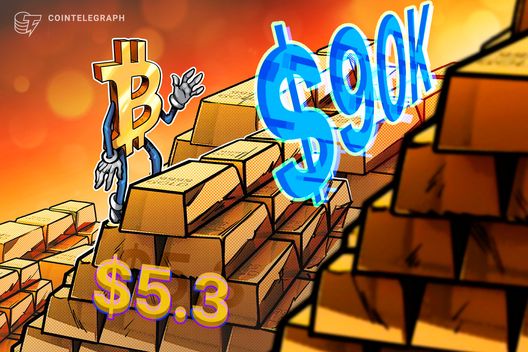
The crypto landscape often mirrors the tumultuous seas of traditional finance, albeit with amplified volatility and unique narratives. However, recent market movements have presented a perplexing dichotomy, challenging one of Bitcoin’s most cherished narratives: its role as ‘digital gold.’ As the Federal Open Market Committee (FOMC) meeting loomed, casting its long shadow over global markets, gold, the age-old inflation hedge, surged to an unprecedented $5.3K record. Concurrently, the U.S. dollar, typically inversely correlated with commodities, saw its strength nosedive. Yet, in a move that disappointed many, Bitcoin failed to capitalize on this macro tailwind, seeing an apparent breakout above the crucial $90,000 mark falter.
This divergence raises critical questions for investors in both traditional and digital assets. Why did gold experience such a meteoric rise, and what held Bitcoin back from mirroring its safe-haven counterpart? More importantly, what does this tell us about Bitcoin’s evolving identity and its susceptibility to broader economic forces?
**Gold’s Unprecedented Ascent: A Safe Haven in Stormy Waters**
Gold’s spectacular rally to a staggering $5.3K record, even as the U.S. dollar weakened significantly, underscores a deep-seated apprehension within global financial markets. This surge is multifaceted. Primarily, it’s a testament to gold’s enduring appeal as a safe-haven asset amidst geopolitical uncertainties and persistent inflation concerns. Investors are increasingly seeking refuge from potential currency debasement, flocking to a store of value that has historically preserved wealth through economic turmoil. The nosedive in U.S. dollar strength further amplified gold’s allure, making dollar-denominated assets cheaper for international buyers and often signaling market expectations of a more dovish stance from the Federal Reserve.
Anticipation ahead of the FOMC meeting likely fueled this flight to safety. Market participants were positioning themselves for potential signals regarding future interest rate cuts or a more accommodative monetary policy, which typically weakens the dollar and boosts gold prices. The narrative here is clear: fear, uncertainty, and a quest for tangible value are driving capital towards the precious metal, reaffirming its millennia-old reputation as the ultimate hedge.
**Bitcoin’s Missed Opportunity: The Digital Gold Narrative Under Scrutiny**
For Bitcoin, the scenario unfolded quite differently. Despite the weakening dollar and gold’s stellar performance – conditions that, in theory, should favor ‘digital gold’ – Bitcoin struggled to maintain momentum above the $90,000 threshold. The failed breakout was a significant disappointment for bulls who anticipated a clear run into new all-time highs, propelled by the same macro forces driving gold. This underperformance puts Bitcoin’s ‘digital gold’ narrative squarely under the microscope.
Several factors might explain this divergence. Firstly, Bitcoin, despite its growing institutional adoption, is still largely perceived as a risk-on asset. While it has shown some safe-haven characteristics in specific geopolitical events, its correlation with traditional tech stocks and broader risk appetite often remains strong. In periods of high macro uncertainty, particularly heading into a crucial FOMC announcement, investors may de-risk from more volatile assets like Bitcoin, opting for the proven stability of gold.
Secondly, the $90,000 level itself likely acted as a significant psychological and technical resistance point. After a period of strong gains, profit-taking tendencies can intensify around such round numbers, especially if conviction for continued upward movement is tempered by macro caution. Furthermore, the institutional flow, while robust earlier in the year, might have temporarily cooled as investors adopted a wait-and-see approach ahead of the Fed’s decision, fearing unexpected hawkish surprises.
**The FOMC’s Shadow: A Test of Market Conviction**
The looming FOMC meeting is central to understanding both gold’s surge and Bitcoin’s hesitation. The market’s interpretation of the Fed’s stance on inflation, economic growth, and future interest rate policy will dictate risk appetite across all asset classes. A more dovish Fed, signaling imminent rate cuts, could further weaken the dollar and potentially send gold even higher, while also providing a catalyst for risk assets like Bitcoin. Conversely, a surprisingly hawkish stance could strengthen the dollar, put downward pressure on gold, and potentially lead to further corrections in the crypto market.
Bitcoin’s failure to follow gold suggests that, for now, its market participants are more acutely sensitive to the ‘risk’ component of macro events than gold’s investors. While both assets offer an alternative to fiat currency, their market structures and investor bases still exhibit fundamental differences. Gold’s market is deep, liquid, and dominated by traditional financial institutions and sovereign entities with a long-term view of capital preservation. Bitcoin, while maturing rapidly, still retains a significant retail component and is subject to quicker shifts in sentiment and speculative trading.
**Looking Ahead: Re-evaluating Bitcoin’s Identity**
The recent decoupling serves as a vital reminder that Bitcoin’s path is not merely a mirror image of gold’s. While its scarcity, decentralization, and resistance to censorship provide a compelling long-term store of value proposition, its short-term price action remains influenced by a complex interplay of speculative flows, technological developments, and evolving macro narratives. The ‘digital gold’ thesis is not dead, but it is undergoing a rigorous test.
As the dust settles post-FOMC, the market will intently watch for cues. Will Bitcoin eventually catch up, proving its resilience and reinforcing its safe-haven credentials? Or will this divergence persist, signaling a more nuanced role for Bitcoin in the global financial ecosystem – perhaps as a unique, uncorrelated digital asset rather than a direct substitute for the precious metal? For now, investors must acknowledge that Bitcoin’s journey to becoming a universally accepted safe haven is still in progress, subject to both its intrinsic merits and the broader macro winds that sway global capital.