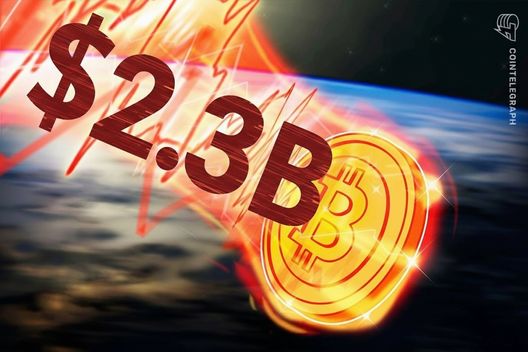
Bitcoin, the flagship cryptocurrency, has recently undergone a staggering downturn, shedding an estimated $2.3 billion in realized losses. This monumental slide, described by analysts as the largest capitulation event since 2021, has sent shockwaves through the digital asset ecosystem. This detailed analysis will delve into the dynamics of this significant market event, exploring its drivers, implications for market structure, and what it might signal for Bitcoin’s future trajectory.
The scale of the recent sell-off isn’t just about nominal price depreciation, but critically, the sheer volume of “realized losses.” Unlike “paper losses,” which are unrealized until an asset is sold, realized losses represent actual capital outflows as investors sell below their purchase price. The reported $2.3 billion underscores the severity, marking a significant transfer of wealth. This magnitude hasn’t been witnessed since the tumultuous 2021 corrections, a period characterized by sharp downturns following unprecedented bull runs. Crucially, these losses are concentrated among “short-term holders” (STHs)—typically defined as those holding Bitcoin for less than 155 days—highlighting that the “weakest hands” are often the most susceptible to panic selling during periods of heightened volatility.
Capitulation, in financial markets, describes widespread selling where investors abandon hope of recouping losses and dump assets, often driving prices significantly lower. For Bitcoin and the broader crypto market, such events are painful but often necessary cleansing mechanisms marked by extreme fear, panic, and a breakdown of previous support levels. The current event’s scale suggests deep conviction among a segment of the market that further declines are imminent, or that their holding capacity has simply been exhausted. This phenomenon is particularly pronounced among STHs, who lack the conviction or financial resilience of long-term holders (LTHs) to endure prolonged downturns, leading to cascading liquidations and exacerbating price declines.
While immediate catalysts are multifaceted, a confluence of macro and crypto-specific factors likely contributed. Globally, persistent inflation, aggressive interest rate hikes by central banks, and looming recession fears have squeezed liquidity from riskier assets like cryptocurrencies. Investors, seeking safer havens, often de-risk their portfolios by shedding more volatile holdings. Regulatory uncertainties continue to cast a long shadow, with increased scrutiny from bodies like the SEC potentially deterring institutional participation. Within crypto, the unwinding of leveraged positions—where traders borrow funds to amplify their bets—can trigger forced liquidations when prices move against them, creating a cascade of sell orders and broader market contagion.
The assertion of record realized losses and intensifying capitulation is strongly supported by sophisticated on-chain analytics. Crypto analysts leverage public blockchain data to gain unparalleled insights into market participant behavior. Metrics like the Spent Output Profit Ratio (SOPR), which indicates whether spent outputs were, on average, moved in profit or loss, become crucial. During capitulation, SOPR often dips significantly below 1, confirming that coins are being sold at a loss. Furthermore, tracking the cost basis of different cohorts, particularly short-term holders, reveals when these groups are selling below their acquisition price. The current data suggests that STHs’ aggregate cost basis has been breached, prompting the recent wave of selling. This precise, data-driven approach allows analysts to differentiate between mere price corrections and genuine capitulation events, offering robust insight into market sentiment and structural shifts.
The implications of such a significant capitulation event are far-reaching. In the short term, markets can remain highly volatile and susceptible to further downside pressure as fear and uncertainty persist. However, historically, capitulation often serves as a necessary “reset” for the market. It cleanses out excessive leverage, washes away the “weak hands,” and transfers coins from impatient sellers to patient, conviction-driven buyers – often long-term holders and institutional players who see value in accumulating during downturns. This redistribution of supply can lay the groundwork for a more stable and resilient market structure, crucial for price discovery and setting new floors from which the next growth cycle can emerge.
Looking ahead, several key indicators will be crucial for investors to monitor. On the macroeconomic front, any signs of easing inflation, a pause in interest rate hikes, or a general improvement in global economic sentiment could provide tailwinds for risk assets. Within the crypto ecosystem, observing the behavior of long-term holders is paramount; a significant increase in accumulation by this cohort, often indicated by metrics like “HODLer Net Position Change,” could signal a potential bottoming process. Furthermore, key technical support levels for Bitcoin will be closely watched; a sustained hold above these levels could alleviate some selling pressure, while a breach could signal further downside. Patience and a long-term perspective will be vital for navigating these turbulent waters.
Bitcoin’s recent $2.3 billion realized loss event, its most significant capitulation since 2021, underscores the cryptocurrency market’s inherent volatility and cyclical nature. While undoubtedly a painful period for many short-term holders, such events, driven by a confluence of macro pressures and internal market dynamics, are often foundational to the asset’s long-term health. They serve to re-establish value, purge unsustainable leverage, and redistribute supply into stronger hands. As the dust settles, the market will likely emerge with a more robust structure, poised for potential future growth. For investors, understanding these cycles and maintaining a disciplined approach, anchored by fundamental analysis and a keen eye on evolving market dynamics, remains crucial for successful participation in the exciting yet unpredictable world of digital assets.