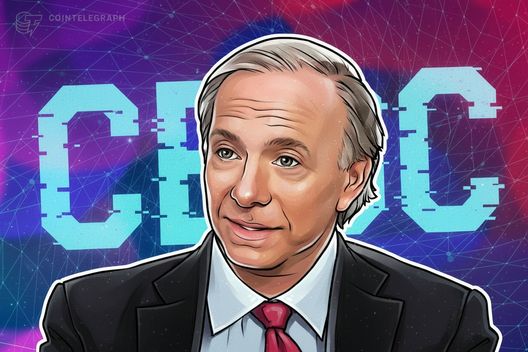
Billionaire hedge fund manager Ray Dalio, renowned for his insightful macroeconomic analysis and founder of Bridgewater Associates, has issued a stark warning that reverberates through the global financial community and the burgeoning crypto landscape. His recent pronouncement — that Central Bank Digital Currencies (CBDCs) are an inevitability that will fundamentally eliminate financial privacy — underscores a critical juncture in the evolution of money and governance. Dalio’s concerns extend beyond mere inconvenience, pointing to a future where governments could possess unprecedented control: the ability to tax, seize funds, and even financially disenfranchise political opponents with alarming ease.
For those of us deeply invested in the principles of decentralized finance and individual liberty that underpin much of the crypto movement, Dalio’s warning is not entirely new, but its articulation by such an influential mainstream figure lends it significant weight. It crystallizes a fear that has long simmered in the digital asset space: that state-backed digital currencies, while promising efficiency and modernization, could inadvertently become the ultimate tool for surveillance and control.
At its core, a CBDC is a digital form of a country’s fiat currency, issued and backed by its central bank. Unlike cryptocurrencies like Bitcoin, which are decentralized and often aim for pseudonymity or true anonymity, most proposed CBDC models are inherently centralized, designed for traceability, and under direct governmental oversight. Proponents argue CBDCs offer numerous benefits: enhanced financial inclusion for the unbanked, reduced transaction costs, faster cross-border payments, and a more robust framework for monetary policy implementation. Some even suggest they could combat illicit activities more effectively than cash.
However, Dalio’s perspective zeroes in on the darker implications of this digital transformation. He posits that the current financial system, despite its flaws, still offers a degree of privacy, particularly with physical cash. A fully digital, centrally controlled CBDC would obliterate this. Every transaction, every spending habit, every financial interaction could be recorded, tracked, and analyzed by the state. This level of granular insight into citizens’ financial lives presents a profound shift in the balance of power between the individual and the government.
Consider the implications of ‘programmable money,’ a concept frequently discussed in CBDC circles. While framed as a feature to facilitate targeted aid or incentivize specific behaviors, it also carries the dystopian potential to dictate *how*, *when*, and *where* citizens can spend their own money. A government could, theoretically, program funds to expire if not spent by a certain date, or restrict their use to specific categories of goods and services, or even prevent purchases from entities deemed undesirable. This isn’t just about taxation; it’s about the potential for absolute financial conditioning.
Dalio’s alarm about the government’s ability to ‘seize funds’ and ‘cut off political opponents’ is particularly chilling. In a CBDC-only world, where all financial activity is digital and centralized, the state could instantly freeze accounts or block transactions of individuals or groups deemed a threat, without needing complex legal processes or court orders. This effectively weaponizes the financial system, turning it into a potent instrument of political coercion and social control. We’ve seen glimpses of this power in action, for instance, during the Canadian truckers’ protests where bank accounts were frozen. A full-fledged CBDC infrastructure would render such actions far more swift, comprehensive, and difficult to circumvent.
For the crypto community, Dalio’s warning serves as both a validation of core tenets and a urgent call to action. The very existence of Bitcoin was born out of a desire for a decentralized, censorship-resistant form of money, free from central bank manipulation and governmental oversight. Privacy coins like Monero or Zcash offer technological solutions to financial anonymity. The ethos of self-custody and permissionless access that defines the broader Web3 movement stands in stark contrast to the centralized, permissioned, and highly surveilled future that Dalio fears CBDCs will usher in.
This isn’t to say all CBDCs are inherently nefarious. Some proposals explore models with tiered privacy or token-based systems that might offer more user control. However, the fundamental tension between a government’s desire for control and an individual’s right to financial privacy remains unresolved. As nations race to develop their own digital currencies – with China notably advanced in its Digital Yuan project – the debate needs to intensify, not diminish.
Ray Dalio’s warning is a crucial intervention. It compels us to move beyond the technocratic arguments for efficiency and convenience and confront the profound societal and individual liberty implications of CBDCs. As financial systems evolve, the global community, policymakers, and citizens must engage in a robust dialogue about safeguards, privacy-by-design principles, and the limits of state power in the digital age. The future of financial freedom, it seems, may well hinge on the choices we make regarding central bank digital currencies.