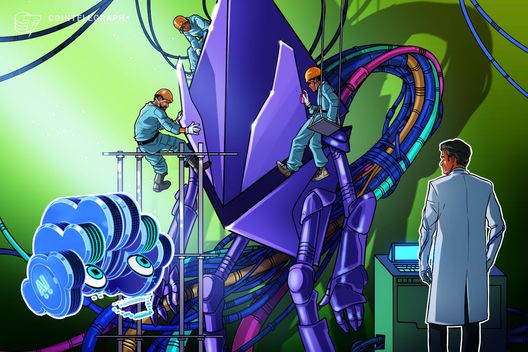
The convergence of artificial intelligence and blockchain technology has long been a subject of fervent discussion within the Web3 ecosystem. For years, the vision of autonomous, intelligent agents operating within decentralized networks remained largely conceptual, hampered by the lack of a standardized, trustless framework for their interaction. That could all change as early as Thursday, with the anticipated deployment of ERC-8004, a groundbreaking Ethereum standard, to the mainnet.
ERC-8004, as described by its lead developers, is poised to be a pivotal moment for both AI and blockchain. Its core innovation lies in enabling AI agents to discover, communicate, and trust each other across diverse platforms without relying on centralized intermediaries. As a Senior Crypto Analyst, I view this as a foundational step towards realizing truly decentralized AI – a paradigm shift with profound implications for everything from automated finance to next-generation digital identities.
**The Problem of Centralized Trust in AI**
To understand the significance of ERC-8004, one must first grasp the limitations of current AI systems. Today, most AI agents operate within walled gardens or rely on centralized platforms for discovery, authentication, and interaction. This architecture introduces several critical vulnerabilities:
1. **Single Points of Failure**: Centralized systems are susceptible to outages, censorship, and malicious attacks, compromising the reliability and autonomy of AI agents.
2. **Data Silos and Lack of Interoperability**: AI agents developed by different entities often struggle to communicate or exchange information securely and reliably, limiting their collaborative potential.
3. **Opaque Trust Mechanisms**: Verifying the provenance, capabilities, or ethical behavior of an AI agent can be challenging. Trust is often implicitly placed in the platform provider, not the agent itself.
4. **Vendor Lock-in**: Developers and users are often tied to specific platforms, hindering innovation and fostering monopolistic tendencies.
ERC-8004 directly addresses these issues by leveraging Ethereum’s immutable ledger and robust cryptographic security. It provides a standardized framework for AI agents to possess self-sovereign identities, verifiable credentials, and discoverability mechanisms directly on the blockchain.
**How ERC-8004 Forges Trustless Interoperability**
At its heart, ERC-8004 allows an AI agent to establish a verifiable, unique identity on the Ethereum blockchain. Think of it as a digital passport for an AI, cryptographically secured and universally recognizable. With this identity, agents can:
* **Issue Verifiable Credentials**: An AI agent can attest to its own capabilities, training data, algorithmic biases, or operational history. For instance, an AI market analysis agent could issue a credential verifying its average prediction accuracy over time, signed cryptographically on-chain. Other agents (or human users) can then independently verify these claims.
* **Discover Peers Trustlessly**: Instead of relying on a centralized directory, agents can query the blockchain to find other agents based on their registered capabilities, reputation scores, or the verifiable credentials they possess. This enables dynamic, ad-hoc collaborations.
* **Establish Secure Communication Channels**: While the standard itself doesn’t define the communication protocol, by establishing a trustless identity, agents can then securely authenticate and encrypt their communication directly, knowing they are interacting with the genuine, verified peer.
* **Automate Interactions via Smart Contracts**: The interactions and agreements between AI agents can be enshrined and enforced by smart contracts. This allows for automated, programmatic execution of tasks, exchanges of data, or even financial transactions without human oversight or external arbitration.
**Transformative Use Cases and Implications**
The implications of trustless AI agent interoperability are vast and extend across virtually every sector:
* **Decentralized Autonomous Organizations (DAOs)**: Imagine DAOs where sophisticated AI agents manage treasury operations, execute complex proposals, or even develop new code, with their actions verifiable and auditable on-chain.
* **Next-Gen Financial Services**: AI trading bots could interact with each other in a trustless environment, executing complex arbitrage strategies, managing liquidity, or underwriting decentralized insurance policies with unprecedented transparency and efficiency.
* **Supply Chain and Logistics**: AI agents could autonomously manage inventory, verify product provenance, negotiate shipping routes, and even settle payments, all with verifiable trust and resistance to manipulation.
* **Personalized AI Assistants**: Your personal AI could securely and privately interact with various service-provider AIs (e.g., booking agents, health advisors, financial planners) across different platforms, all while maintaining your data sovereignty and trust.
* **Gaming and Metaverse**: AI-driven NPCs (Non-Player Characters) could exhibit more complex, autonomous behaviors, engaging in trustless interactions with other AI or human players, creating richer, more dynamic virtual worlds.
**Challenges and the Road Ahead**
While ERC-8004 presents a monumental leap forward, its path to widespread adoption will not be without challenges. Ethereum’s current scalability limitations, primarily high gas fees and transaction throughput, could impact the cost and speed of agent interactions. However, the rapidly maturing Layer 2 ecosystem offers promising solutions here, offloading much of the transactional load from the mainnet.
Furthermore, the complexity of developing sophisticated AI agents that interact securely and reliably on-chain will require a new breed of developers skilled in both AI and blockchain engineering. Ethical considerations, such as preventing malicious AI agents or resolving disputes between autonomous entities, will also necessitate careful thought and potentially new governance frameworks.
**Conclusion: A Foundation for the Future**
ERC-8004’s deployment to the Ethereum mainnet marks a critical juncture in the evolution of both AI and Web3. It moves us beyond mere theoretical discussions about decentralized AI and provides a concrete, standardized protocol for building it. By empowering AI agents with self-sovereign identity and trustless interoperability, ERC-8004 lays a robust foundation for a future where intelligent machines can collaborate autonomously, securely, and transparently, unlocking unprecedented levels of innovation and efficiency. The era of truly decentralized, trustless AI is not just on the horizon; it’s arriving on Ethereum, and its impact will resonate across the digital landscape for decades to come.