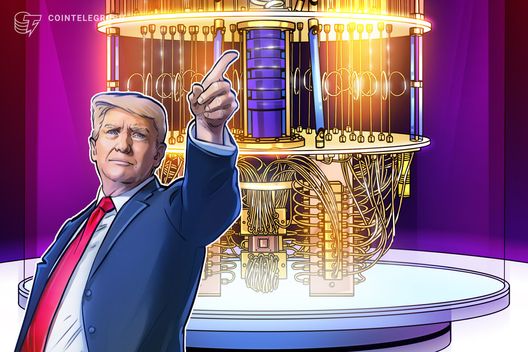
The recent unveiling of former President Donald Trump’s National Cyber Strategy has sent ripples of speculation through the cryptocurrency ecosystem. With a declared pledge to “support crypto and blockchain,” the document, while broad, immediately sparked industry-wide discussions, particularly concerning its potential implications for highly debated aspects like mixers, privacy coins, and the long-term existential threat of quantum computing to foundational assets like Bitcoin. As a Senior Crypto Analyst, it’s crucial to dissect this high-level pronouncement and explore the complex interplay between national cybersecurity objectives and the rapidly evolving digital asset landscape.
**The “Support” Pledge: A Double-Edged Sword?**
At first glance, a presidential strategy explicitly endorsing “support” for crypto and blockchain appears unequivocally positive. In an environment often characterized by regulatory uncertainty and even hostility from some quarters, such a stance could signal a new era of clarity, innovation encouragement, and potentially even regulatory frameworks designed to foster growth rather than stifle it. This might involve streamlined licensing, reduced compliance burdens for legitimate actors, or even federal initiatives to explore blockchain’s utility in government operations. However, the devil will inevitably be in the details. “Support” can be interpreted in various ways, from championing technological advancement to asserting national control over emerging financial infrastructure. The critical question remains: what *kind* of support, and under what conditions?
**Mixers, Privacy Coins, and the Regulatory Tightrope:**
The mention of mixers and privacy coins immediately raises red flags for privacy advocates while simultaneously triggering national security concerns for regulators. Mixers (like Tornado Cash, before its sanctions) and privacy-centric cryptocurrencies (such as Monero or Zcash) are designed to enhance transactional anonymity, making it difficult to trace funds. While invaluable tools for financial privacy and censorship resistance, they have also been exploited by malicious actors, including state-sponsored groups and ransomware gangs, leading to aggressive crackdowns from bodies like OFAC and FinCEN.
A strategy pledging “support” for crypto must inevitably confront this dichotomy. How can a national cyber strategy support blockchain innovation while simultaneously addressing the illicit finance risks posed by these privacy-enhancing tools? One interpretation could be a push for a more nuanced regulatory framework that differentiates between legitimate privacy use cases and criminal activity, perhaps through enhanced investigative capabilities rather than outright bans. Alternatively, “support” might imply fostering permissioned blockchains or CBDCs, which offer transparency and control, while inadvertently or explicitly marginalizing truly private, decentralized alternatives. This tension between individual financial freedom and national security imperatives will be a defining challenge for any administration seeking to operationalize this pledge. A Trump administration might lean into an “America First” approach, prioritizing US-based innovation but under stringent oversight, potentially at the expense of truly permissionless, global privacy-preserving protocols.
**Quantum Computing: The Looming Shadow over Bitcoin’s Security:**
Perhaps the most forward-looking and potentially disruptive point of speculation pertains to quantum computing’s threat to Bitcoin. The theoretical ability of a sufficiently powerful quantum computer, leveraging Shor’s algorithm, to break the elliptical curve digital signature algorithm (ECDSA) that secures Bitcoin’s transactions and wallets is a known, albeit distant, concern. Such a breakthrough could theoretically allow an attacker to forge signatures and drain funds from unspent transaction outputs (UTXOs).
A national cyber strategy addressing this threat signifies a profound understanding of future digital vulnerabilities. It suggests a commitment to investing in post-quantum cryptography (PQC) research and development, potentially even advocating for global standards for quantum-resistant algorithms. For Bitcoin, this could translate into a long-term roadmap for protocol upgrades to incorporate PQC, a significant undertaking requiring broad consensus. While the “quantum apocalypse” for Bitcoin is not an immediate threat – practical, fault-tolerant quantum computers capable of breaking ECDSA are likely decades away – strategic foresight is critical. A national strategy could catalyze research into PQC, establish ‘quantum-safe’ standards for critical infrastructure, and even explore defensive measures to protect existing cryptographic assets. This proactive stance would be crucial not just for Bitcoin but for the entire digital security landscape, reinforcing the integrity of encrypted communications and digital identities.
**Broader Implications and The Road Ahead:**
Beyond these specific points, Trump’s strategy, if implemented, could position the U.S. as a leader in blockchain innovation, potentially attracting significant investment and talent. It could foster a competitive environment where regulatory clarity allows American companies to build and scale without fear of abrupt policy shifts. However, the inherent complexity of translating a strategic vision into actionable policy cannot be overstated. Any administration would need to navigate the intricate balance between fostering innovation, safeguarding national security, ensuring financial stability, and protecting consumers.
The industry’s reaction has been one of cautious optimism tempered by historical experience. While the pledge to support crypto is a positive signal, the practical execution and the detailed policy directives that emerge will ultimately determine its impact. Will it be a strategy that truly embraces the decentralized ethos of crypto, or one that seeks to tame it within traditional frameworks?
**Conclusion:**
Trump’s National Cyber Strategy offers a tantalizing glimpse into a potential future where the U.S. government actively “supports crypto and blockchain.” However, the path forward is fraught with critical distinctions and complex trade-offs. The treatment of mixers and privacy coins will be a litmus test for the administration’s stance on financial privacy versus surveillance, while its approach to quantum computing will define its commitment to long-term digital security. As Senior Crypto Analysts, our role is to monitor these developments closely, advocating for policies that foster innovation responsibly, protect user privacy, and secure the digital future against emerging threats. The coming years will reveal whether this strategic pledge paves the way for a vibrant, secure, and truly innovative crypto ecosystem, or merely provides rhetorical cover for a more controlled digital future.