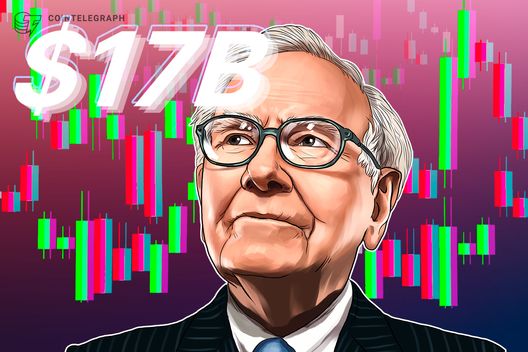
Warren Buffett, the revered ‘Oracle of Omaha,’ needs no introduction in financial circles. His investment philosophy, characterized by value investing and a keen eye for enduring businesses, has yielded unparalleled success for Berkshire Hathaway shareholders over decades. When Buffett makes a move, the market pays attention. His recent decision to park a staggering $17 billion in short-term U.S. Treasury Bills, coupled with his dismissive characterization of the current stock market dip as “nothing” compared to historical 50% crashes, has sent ripples through the investment world. For risk assets, particularly the volatile cryptocurrency market, these signals beg a critical question: Is Buffett’s cautious pivot a harbinger of tougher times for Bitcoin, potentially extending into 2026? As senior crypto analysts, we must dissect the implications of this traditional finance giant’s actions on the digital asset landscape.
Buffett’s affinity for Treasury Bills is not novel; during uncertainty, T-bills offer safety and guaranteed returns with negligible default risk. This $17 billion allocation signals a clear preference for capital preservation and liquidity. This move is particularly striking when juxtaposed with his historical aversion to assets he deems ‘unproductive,’ a category into which he has famously, and often controversially, placed Bitcoin.
More profoundly, Buffett’s recent comments about the stock market provide a window into his long-term macroeconomic outlook. To dismiss current market volatility as mere ‘noise’ against the backdrop of past, more severe downturns (like the Dot-com bubble bust or the 2008 financial crisis) is to implicitly suggest that the *real* pain for risk assets is yet to come. His projected timeline for this potential downside, hinting at 2026, extends beyond typical short-term market corrections, implying structural economic challenges or a prolonged period of asset revaluation. This isn’t just a tactical retreat; it’s a strategic positioning for a potentially more challenging financial environment.
How does the Oracle’s caution translate to Bitcoin? The primary mechanism is through a reinforced ‘risk-off’ sentiment. When a titan like Buffett signals a flight to safety, institutional investors, and even informed retail investors, tend to re-evaluate their exposure to high-beta assets. Bitcoin, despite its growing maturity, still largely trades as a speculative risk asset, highly correlated with technology stocks and overall market sentiment. A broad market downturn, especially if prolonged, almost invariably leads to deleveraging and capital withdrawal from riskier assets, with crypto often bearing the brunt.
Furthermore, Buffett’s T-bill play highlights the rising opportunity cost of holding non-yielding assets. In a zero-interest-rate environment, holding Bitcoin, despite its volatility, offered an attractive speculative upside with minimal opportunity cost from traditional safe havens. However, with T-bills now offering meaningful yields (around 5% for short-term bills), the calculus changes dramatically. Investors can secure a decent, risk-free return, making the prospect of holding a volatile asset like Bitcoin, which yields nothing intrinsically, less appealing, especially for those prioritizing capital preservation. This dynamic pressures Bitcoin’s store-of-value narrative unless its price appreciation drastically outperforms these safe yields, a feat challenging in a tightening monetary environment.
While Buffett’s macro view certainly casts a long shadow, it’s crucial to analyze Bitcoin through its own lens. Bitcoin is not merely a stock; it possesses unique characteristics and drivers that differentiate it from traditional equities. Its scarcity (capped at 21 million coins), decentralized nature, and censorship resistance are often cited as its core value propositions, positioning it as ‘digital gold’ or a hedge against fiat inflation and systemic financial instability. However, even these unique strengths have struggled to decouple Bitcoin entirely from broader market dynamics in recent years. During significant market dislocations, the ‘digital gold’ narrative often gives way to a liquidity grab, as investors sell whatever they can to cover losses elsewhere. Furthermore, Bitcoin’s institutionalization, while legitimizing the asset, has increased its correlation with traditional finance metrics. The approval of spot Bitcoin ETFs, for instance, has opened doors to a broader investor base but also tethered its performance more closely to Wall Street’s perception of risk and reward.
Critics of Buffett’s crypto skepticism often point to his historical track record of missing major technological shifts, most notably his initial reluctance to invest in tech giants like Apple until much later. Could his stance on Bitcoin be another such ‘blind spot’? Proponents argue that Bitcoin represents a paradigm shift in finance, a non-sovereign, censorship-resistant, verifiable digital asset that offers a compelling alternative in an increasingly uncertain global economic landscape. They contend that if traditional markets face a deep, prolonged downturn, Bitcoin’s role as an alternative financial rail could ironically strengthen long-term, perhaps after initial capitulation.
The 2026 timeline is also critical. Three years in crypto is an eternity. During this period, we could see further regulatory clarity, technological advancements (e.g., scalability improvements, wider adoption of Layer 2 solutions), and potentially another Bitcoin halving event (expected around April 2024), which historically has been a bullish catalyst. These crypto-native factors could provide tailwinds that counterbalance some of the broader macroeconomic pressures.
Warren Buffett’s $17 billion T-bill purchase and his gloomy market forecast are undeniably significant signals. For Bitcoin, they imply a challenging road ahead in the short to medium term. The heightened risk-off sentiment, coupled with rising opportunity costs from traditional safe havens, suggests that sustained upward momentum will be difficult to achieve, and further downward pressure is a distinct possibility, especially if his 2026 prognosis for traditional markets holds true.
However, astute crypto investors should view this not as a definitive death knell, but as a critical juncture. While Bitcoin will likely continue to feel the gravitational pull of traditional market forces, its unique properties and growing ecosystem suggest a potential for eventual decoupling or a reassertion of its value proposition as a systemic risk hedge – perhaps when traditional assets are at their nadir. Investors should brace for continued volatility, prioritize risk management, and understand that while the Oracle of Omaha’s wisdom is invaluable for traditional markets, Bitcoin’s ultimate trajectory may yet surprise those who discount its revolutionary potential.