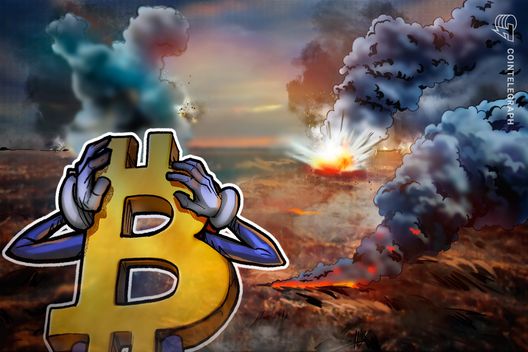
Bitcoin, often touted as ‘digital gold’ and a hedge against geopolitical instability, finds itself in a precarious position as global tensions escalate. The ongoing conflict between the U.S. and Israel against Iran, now entering its fourth week, has deepened Bitcoin’s recent weakness, pushing traders to aggressively cut risk across both traditional equities and the nascent digital asset market. As a Senior Crypto Analyst, our assessment indicates a complex interplay of geopolitical fear, macroeconomic headwinds, and a significant shift in institutional sentiment driving the current downturn.
Since the conflict’s initial flare-up, markets globally have been gripped by uncertainty. While traditional safe-havens like the U.S. Dollar and gold have seen renewed interest, Bitcoin’s performance has largely mirrored that of risk assets. This correlation has been particularly pronounced, with BTC price action closely tracking major equity indices, rather than decoupling as some maximalists might have hoped. The narrative of Bitcoin as an uncorrelated asset, especially during times of crisis, is facing one of its sternest tests to date, and for now, it appears to be falling short.
A critical indicator of this broader risk aversion is the soaring outflows from both Bitcoin and equities ETFs. For several weeks now, we’ve witnessed consistent net outflows from spot Bitcoin ETFs, reversing the initial euphoria and significant inflows seen post-launch. This isn’t merely retail jitters; institutional capital, which initially fueled much of the ETF hype, is now demonstrating a clear de-risking strategy. Institutional investors, typically with more sophisticated risk management frameworks, are often the first to pull back in uncertain environments, seeking liquidity and minimizing exposure to volatile assets. These outflows signify a waning short-term conviction and suggest that the institutional bid, once seen as an unstoppable force, is susceptible to broader market sentiment and geopolitical shifts.
The implications of sustained ETF outflows are profound. They not only remove buying pressure but can also contribute to deeper liquidations as market makers adjust positions. Coupled with outflows from equity ETFs, it paints a picture of systemic caution – investors are not just reducing their crypto exposure, but actively shedding risk across their entire portfolios. This wholesale de-risking implies a fear of broader economic contagion or prolonged instability that transcends individual asset classes.
Beyond the immediate geopolitical concerns, underlying macroeconomic factors continue to provide a challenging backdrop for risk assets. Stubborn inflation figures in major economies, particularly the U.S., have led to revised expectations for interest rate cuts. The ‘higher for longer’ interest rate narrative strengthens the U.S. Dollar (DXY) and puts upward pressure on bond yields, making safer, fixed-income investments more attractive relative to volatile assets like Bitcoin. This economic reality amplifies the impact of geopolitical events, creating a perfect storm for assets perceived as risky.
Bitcoin’s failure to act as a safe-haven in this environment forces a re-evaluation of its current market positioning. While its long-term potential as a store of value and an alternative financial system remains compelling, its short-to-medium-term price action is undeniably tied to global liquidity conditions and risk appetite. When central banks maintain tight monetary policies and geopolitical tensions escalate, Bitcoin’s liquidity premium evaporates, and it trades more like a speculative technology stock than a digital equivalent of gold.
Looking ahead, the path to recovery for Bitcoin appears contingent on several factors. A de-escalation of the Middle East conflict would undoubtedly ease market anxieties, potentially leading to a return of risk-on sentiment. Similarly, clearer signals from central banks regarding future monetary policy, particularly a definitive pivot towards rate cuts, could inject fresh liquidity into markets. However, until such clarity emerges, Bitcoin is likely to remain highly sensitive to news flow, with periods of high volatility and further downside potential.
For investors, this period necessitates a strategic, rather than reactive, approach. While the current environment presents significant challenges and tests conviction, it also highlights the importance of understanding Bitcoin’s evolving role within the broader financial ecosystem. Its journey towards maturity is still underway, and periods like these, while painful, offer crucial lessons on its true market correlations and resilience under extreme duress. The current weakness is a stark reminder that even innovative assets like Bitcoin are not immune to the gravitational pull of global events and fundamental market dynamics.