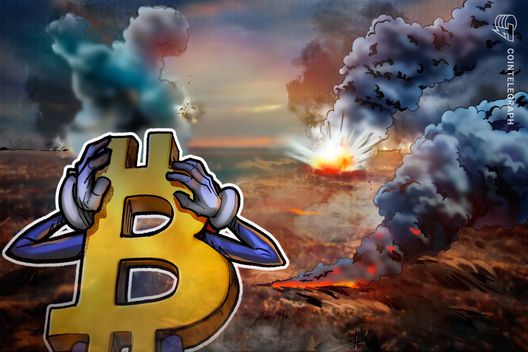
The crypto market finds itself ensnared in a deepening vortex of geopolitical uncertainty, with Bitcoin’s (BTC) resilience under severe scrutiny. As the US and Israel-Iran conflict enters its fourth fraught week, global financial markets are signaling a pronounced flight to safety, manifesting in significant outflows from both equities and, crucially, Bitcoin Exchange-Traded Funds (ETFs). This prolonged period of ‘risk-off’ sentiment has left Bitcoin’s price notably rocky, challenging its burgeoning narrative as a decentralized ‘digital gold’ hedge against traditional market turmoil.
For senior crypto analysts, the current landscape presents a complex interplay of macroeconomic forces, investor psychology, and the inherent characteristics of a still-maturing asset class. The initial allure of Bitcoin as a safe haven, uncorrelated with legacy financial systems, has been a cornerstone of its investment thesis, particularly in times of inflationary pressure or geopolitical instability. Yet, the past month has seen BTC largely behave as a risk asset, echoing the movements of growth stocks and the broader equities market, rather than charting an independent course. This correlation suggests that in moments of acute global stress, institutional and retail investors alike are prioritising capital preservation, pulling funds from perceived higher-risk assets across the board.
The ‘fourth week’ marker of the US and Israel-Iran conflict is particularly significant. It moves the situation beyond an immediate shock and into a sustained period of elevated tension, introducing an element of weariness and strategic de-risking among market participants. Geopolitical crises, by their nature, are unpredictable, creating a pervasive sense of uncertainty that typically stifles investment in volatile assets. Traders and institutional funds are opting to cut exposure, fearing potential escalation, supply chain disruptions, or broader economic fallout. This cautious stance invariably translates into selling pressure on assets that lack the perceived stability of government bonds or traditional safe-haven commodities like gold.
The soaring outflows from both Bitcoin and equities ETFs serve as a powerful barometer of this prevailing sentiment. The introduction of spot Bitcoin ETFs earlier this year was hailed as a watershed moment, democratizing access for institutional capital and validating Bitcoin as a legitimate asset class. However, the very mechanisms that facilitate institutional adoption – ease of entry and exit – also allow for swift capital reallocation during crises. When investors, particularly institutional ones, seek liquidity and safety, ETFs become efficient vehicles for shedding risk. The simultaneous outflows from both BTC and equities ETFs underscore a uniform withdrawal from assets perceived to be susceptible to a deteriorating global outlook, rather than a nuanced shift within asset classes. This challenges the notion that Bitcoin, given its nascent ETF structure, would attract contrarian capital seeking refuge *from* traditional markets; instead, it’s being treated as part of the broader risk bucket.
From a technical perspective, Bitcoin’s ‘rocky price’ reflects sustained selling pressure and a struggle to hold key support levels. While dip-buying interest might emerge on significant pullbacks, the persistent macro overhang prevents any meaningful, sustained upward momentum. On-chain metrics, when viewed through this lens, might show long-term holders remaining steadfast, but short-to-medium term traders and those more sensitive to macro shifts are likely driving much of the recent selling. The current environment tests the conviction of even the most ardent Bitcoin maximalists, as the asset’s price action seems to momentarily abandon its ‘digital gold’ thesis in favor of a risk-asset correlation.
The broader implications extend beyond Bitcoin’s price chart. This period of intensified geopolitical risk and subsequent market reaction provides crucial data points for Bitcoin’s long-term trajectory. Is its volatility inherently too high to serve as a reliable safe haven during global conflict? Or is this merely a temporary phase, a reflection of its relatively small market capitalization compared to gold, and its increasing integration into the broader financial ecosystem? The answer likely lies in a nuanced understanding: Bitcoin is still maturing, and its correlation with traditional risk assets during extreme stress may persist until its market cap and liquidity are orders of magnitude larger, or until a clearer decoupling of its underlying narrative from broader economic cycles emerges.
As Senior Crypto Analysts, our focus remains on monitoring the confluence of these factors. A de-escalation of geopolitical tensions, coupled with a renewed appetite for growth and innovation, would likely see capital flow back into risk assets, including Bitcoin. However, until such a shift occurs, investors must navigate a landscape where Bitcoin’s price remains deeply intertwined with the broader macroeconomic and geopolitical currents. The ‘digital gold’ narrative is not dead, but it is undoubtedly undergoing its most rigorous real-world stress test to date, reminding us that even revolutionary assets are not immune to the gravitational pull of global events.
Cautious optimism and strategic patience will be paramount. Investors should remain vigilant, understand the interconnectedness of global markets, and consider portfolio diversification that accounts for both the potential upside of disruptive technologies and the undeniable realities of geopolitical risk.