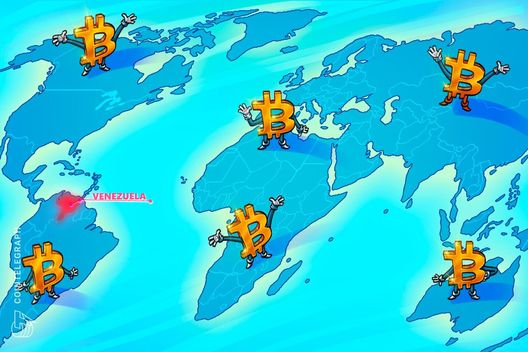
The intricate dance between global geopolitics and financial markets has long been a predictable waltz: escalating tensions send traditional ‘risk-on’ assets scurrying for cover, while safe havens like gold or government bonds see an influx of capital. Yet, in a striking departure from this established playbook, Bitcoin, often deemed a high-beta, risk-on digital asset, has demonstrated remarkable resilience amid heightened US-Venezuela geopolitical strains. This phenomenon demands a closer examination, challenging conventional wisdom and hinting at Bitcoin’s evolving role in the global financial architecture.
Historically, any significant geopolitical shock – be it regional conflicts, trade wars, or diplomatic standoffs – has triggered a knee-jerk negative reaction across equity markets, commodity prices, and emerging market currencies. The underlying mechanism is simple: uncertainty breeds fear, fear leads to de-risking, and de-risking translates into capital flight from volatile assets. The US-led economic sanctions and diplomatic pressure against Venezuela, characterized by many as an ‘attack’ given its severe economic repercussions, certainly fits the bill of a significant geopolitical event. Such actions often disrupt supply chains, impact energy markets (Venezuela being an oil-rich nation), and create widespread economic instability, justifying a typical ‘risk-off’ market posture.
However, Bitcoin’s price action during this period has been notably stable, if not subtly appreciating. While traditional indices might have registered tremors or outright dips, Bitcoin has largely held its ground, exhibiting a distinct lack of correlation with the usual markers of global instability. This resilience isn’t merely coincidental; it prompts a critical re-evaluation of Bitcoin’s intrinsic value proposition and its perception among a growing cohort of investors and users.
Several hypotheses emerge to explain this curious divergence. The most prominent is the strengthening ‘digital gold’ narrative. Like its physical counterpart, gold, Bitcoin possesses attributes of scarcity, immutability, and decentralization. In times of geopolitical uncertainty, when national currencies might face inflationary pressures or seizure risks, an asset outside the control of any single government becomes increasingly attractive. For citizens in sanction-hit economies like Venezuela, where hyperinflation has ravaged the national currency and access to traditional financial services is restricted, Bitcoin offers a lifeline – a means to preserve wealth, conduct transactions, and bypass oppressive financial controls. This ‘use case’ driven demand, even if localized, can bolster the global perception of Bitcoin as a hedge against governmental overreach and economic instability.
Furthermore, Bitcoin’s 24/7 global liquidity and censorship-resistant nature differentiate it from traditional assets. While conventional markets may halt trading or face regulatory hurdles in times of crisis, Bitcoin’s peer-to-peer network continues unabated. This uninterrupted functionality might contribute to its appeal as a reliable store of value and medium of exchange when other financial channels are compromised. The ongoing institutional adoption narrative also plays a role; as more sophisticated investors allocate portions of their portfolios to Bitcoin for diversification, the asset’s overall market maturity increases, potentially leading to more nuanced and less reactive price movements during singular geopolitical events.
Another perspective suggests that the sheer scale of the global crypto market, coupled with its increasing independence from traditional financial narratives, might be at play. While the US-Venezuela situation is significant regionally, the overall impact on the multi-trillion-dollar global cryptocurrency market might be less pronounced than on, say, regional equities or specific commodity markets. Instead, Bitcoin’s price may be more influenced by broader macroeconomic trends – such as global inflation expectations, central bank monetary policies, or the anticipation of future halving events – which might overshadow the immediate implications of localized geopolitical shocks.
However, it’s crucial to approach this analysis with nuance. One event, no matter how compelling, does not definitively establish a long-term trend of decoupling. The relationship between Bitcoin and traditional risk assets is complex and has shown varying degrees of correlation over time. While the recent resilience is noteworthy, sustained observation across multiple geopolitical flashpoints will be necessary to definitively cement Bitcoin’s status as a reliable safe haven. Regulatory uncertainties, market manipulation risks, and the inherent volatility of a nascent asset class remain factors that could influence its performance.
In conclusion, Bitcoin’s steadfastness amidst the US-Venezuela geopolitical tensions offers a compelling data point for its proponents. It strengthens the argument for Bitcoin as more than just a speculative ‘risk-on’ tech play, pushing it closer to a ‘digital gold’ paradigm. Should this pattern of resilience persist through future global instabilities, it would significantly alter Bitcoin’s investment thesis, attracting an even broader spectrum of investors seeking uncorrelated assets and a hedge against the unpredictable currents of international politics. As a Senior Crypto Analyst, I view this as a pivotal moment, urging the market to look beyond simplistic classifications and recognize Bitcoin’s evolving, and increasingly crucial, role in a complex and ever-changing global financial landscape.