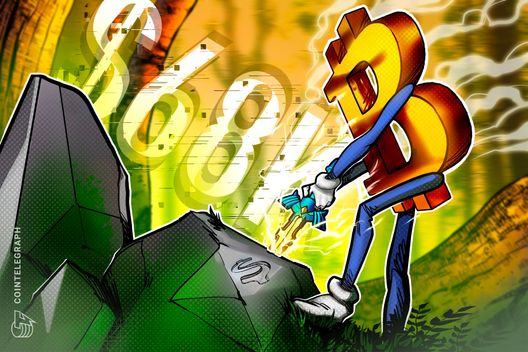
Bitcoin, the bellwether of the cryptocurrency market, has once again demonstrated its increasingly complex relationship with global geopolitics, staging a notable recovery to the $68,000 mark following the death of Iranian Supreme Leader Ayatollah Ali Khamenei. This rebound, occurring amidst a period of heightened regional tensions and economic uncertainty, underscores Bitcoin’s evolving role as an asset sensitive not just to technological advancements or macroeconomic shifts, but also to significant geopolitical tremors.
The immediate aftermath of the announcement saw Bitcoin’s price firm up, signaling a potential shift in investor sentiment. While it’s crucial to avoid simplistic causation in financial markets, the timing of this rally alongside such a monumental geopolitical event invites a deeper analysis into how global political transitions are now perceived through the lens of digital asset markets. Previously hovering below the $66,000 level, Bitcoin’s climb suggests that market participants may be interpreting Khamenei’s demise as either a reduction in a specific form of geopolitical risk or as an opening for potential shifts in regional dynamics that could, in the long term, foster greater stability.
Ayatollah Ali Khamenei, having served as Iran’s Supreme Leader for over three decades, was a figure synonymous with the Islamic Republic’s hardline foreign policy, its nuclear ambitions, and its extensive network of regional proxies. His death inevitably creates a significant power vacuum and ushers in a period of succession uncertainty within one of the Middle East’s most influential nations. Historically, such transitions in authoritarian states can be fraught with instability. However, market reactions often hinge on *perceived* changes in risk, and in this instance, the perception might lean towards a potential de-escalation of certain long-standing tensions, or at least the removal of a known, entrenched adversary.
This sentiment is perhaps best encapsulated by figures like Donald Trump, who, on Truth Social, described Ayatollah Khamenei as “one of the most evil people in history.” Such strong condemnation from a former U.S. President reflects a widespread international perception of Khamenei as a destabilizing force. For some market participants, the removal of such a figure, irrespective of who succeeds him, might be viewed as a net positive, reducing the specter of continued, predictable regional antagonism. This reduction in perceived geopolitical risk, even if temporary or speculative, can often translate into increased investor appetite for riskier assets, including cryptocurrencies.
Bitcoin’s often-debated dual nature – acting both as a ‘digital gold’ safe haven during times of crisis and as a high-beta ‘risk-on’ asset during periods of confidence – plays a critical role here. While some might expect a flight to safety during geopolitical upheaval, the specific nature of this event, the passing of a long-standing authoritarian figure, could be interpreted as reducing a certain type of geopolitical ‘headwind.’ If investors anticipate a potential for reduced friction in the region, or at least a period of re-evaluation, they might reallocate capital towards growth-oriented assets. This doesn’t mean the Middle East will suddenly become stable, but rather that a specific, long-standing element of perceived risk has been removed from the equation.
Beyond the immediate geopolitical catalyst, it’s vital to acknowledge the broader market dynamics that likely supported Bitcoin’s recovery. The cryptocurrency market has been buoyed by sustained institutional interest, evidenced by robust inflows into spot Bitcoin ETFs. Anticipation of potential interest rate cuts by global central banks, alongside the post-halving supply shock, continues to provide underlying bullish momentum. Therefore, the geopolitical event, while significant, likely acted as a positive sentiment booster atop an already supportive fundamental landscape, helping Bitcoin overcome recent consolidation and push towards higher resistance levels.
Looking ahead, the long-term impact of Khamenei’s death on global stability and, by extension, on financial markets including crypto, remains to be seen. The succession process in Iran could lead to further internal power struggles or even a more moderate foreign policy, depending on the chosen successor. For now, however, the market appears to have reacted to the immediate cessation of a long-standing and often antagonistic leadership. Bitcoin’s swift recovery to $68,000 serves as a stark reminder that in an increasingly interconnected world, even digital assets, once considered niche, are now inextricably linked to the intricate tapestry of global politics and the subtle shifts in investor perception that these events engender.
As crypto markets mature, their sensitivity to such high-impact global events will only grow, demanding a more nuanced analytical approach from investors seeking to navigate this dynamic landscape. The confluence of fundamental adoption, macroeconomic shifts, and now, potent geopolitical catalysts, paints a picture of Bitcoin as a truly global asset, responsive to the pulses of the world stage.