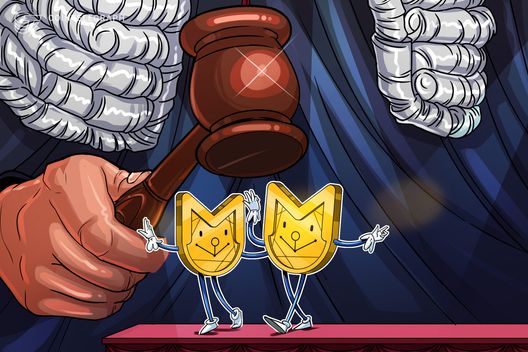
A recent federal court decision to dismiss a class-action lawsuit against Caitlyn Jenner over her eponymous memecoin (JENNER) has sent ripples through the digital asset ecosystem. The judge’s finding that the token did not plausibly allege to be an unregistered security marks a significant, albeit narrow, moment in the ongoing battle for regulatory clarity in the United States. As a Senior Crypto Analyst, I believe this ruling offers crucial insights into how courts may interpret the ‘security’ classification for speculative digital assets, particularly memecoins, while also highlighting the persistent challenges faced by investors and regulators alike.
The lawsuit, filed by plaintiffs who claimed to have lost money investing in the Solana-based JENNER token, alleged that Jenner promoted an unregistered security in a pump-and-dump scheme. The core of their argument rested on the premise that the JENNER token constituted an ‘investment contract’ under the seminal Howey Test, thereby falling under the purview of federal securities laws. However, the federal judge presiding over the case disagreed, stating that the plaintiffs failed to adequately demonstrate that the token met the criteria to be deemed a security. This distinction – a failure to *plausibly allege* rather than a definitive declaration that *all* memecoins are not securities – is paramount.
At the heart of any ‘security’ determination in the U.S. lies the Howey Test, established by the Supreme Court in 1946. It defines an investment contract as an investment of money in a common enterprise with a reasonable expectation of profits to be derived from the entrepreneurial or managerial efforts of others. While the Howey Test has been widely applied to various digital assets by the SEC, its application to the unique characteristics of memecoins has always been a contentious area.
Memecoins, by their very nature, often lack a formal business plan, a dedicated development team with clear managerial responsibilities, or a defined utility beyond speculative trading and community sentiment. Unlike equity tokens that might grant governance rights or a share in a company’s profits, or utility tokens designed to access a specific network service, memecoins often derive their value from viral social media trends, celebrity endorsements, and community-driven speculation. In the case of JENNER, the judge likely found that the plaintiffs could not sufficiently demonstrate the existence of a ‘common enterprise’ with a clear expectation of profits derived *solely* from the ‘managerial efforts of others’ in a way that would classify the token as a security.
This ruling implicitly underscores the difficulty of fitting the square peg of memecoins into the round hole of traditional securities regulation. When a token’s value is driven primarily by an amorphous, decentralized community and speculative fervor, attributing its success or failure to the ‘managerial efforts’ of a specific entity becomes challenging. Caitlyn Jenner’s involvement, while undoubtedly influencing price action and trading volume, appears to have been viewed more as an endorsement or promotional activity rather than the ‘entrepreneurial or managerial efforts’ that would satisfy the Howey Test’s third prong for an investment contract.
The implications of this decision are multifaceted. For celebrity endorsers of digital assets, it might offer a sliver of relief, suggesting that simply promoting a memecoin, without more, may not automatically expose them to liability under securities laws. However, it is crucial to note that this does not absolve them of potential liability under anti-fraud statutes or consumer protection laws if misrepresentations or inadequate disclosures are made. The distinction between a security violation and a fraud violation remains vital. Furthermore, the ruling could embolden other developers and communities to launch similar speculative tokens, potentially believing they have a clearer path to avoid securities classification.
For the broader crypto market, this decision could be interpreted as a subtle pushback against the SEC’s expansive view of what constitutes a security in the digital asset space. While not a direct challenge to the SEC, a federal court dismissing a securities claim for a high-profile memecoin suggests a judicial willingness to scrutinize the specific allegations made against a token under the Howey framework, rather than applying a blanket ‘security’ label. This could contribute to the ongoing debate between the SEC (which generally views many tokens as securities) and the CFTC (which generally views some tokens as commodities).
However, investors should exercise extreme caution in interpreting this ruling. It does not mean memecoins are ‘safe’ or somehow ‘legitimized’ as investment vehicles. On the contrary, if a token is not classified as a security, it means investors are stripped of many of the protections afforded by securities laws, such as mandatory disclosures, registration requirements, and robust anti-fraud provisions designed to ensure market transparency and fairness. The ‘buyer beware’ principle becomes even more pronounced. The inherent volatility, lack of underlying fundamentals, and susceptibility to market manipulation that characterize many memecoins remain significant risks.
In conclusion, the dismissal of the lawsuit against Caitlyn Jenner’s memecoin is a notable development. It provides a specific judicial interpretation that, at least in this instance, found the plaintiffs’ allegations insufficient to classify the JENNER token as an unregistered security. This outcome offers a nuanced victory for those arguing against a broad application of securities laws to highly speculative, community-driven digital assets. Nevertheless, it does not provide a definitive roadmap for the entire crypto industry nor does it diminish the substantial risks associated with investing in memecoins. Instead, it reaffirms the urgent need for comprehensive and tailored regulatory frameworks that can adequately address the unique characteristics of digital assets, balancing innovation with investor protection in this rapidly evolving financial landscape.