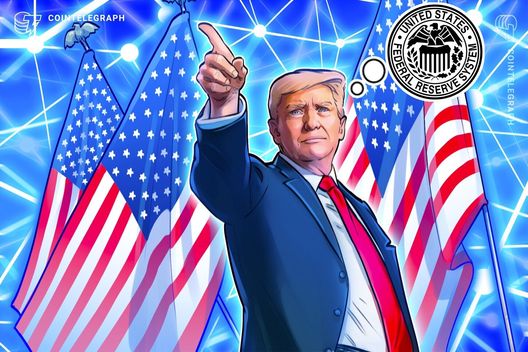
President Donald Trump’s recent public exhortation for Federal Reserve Chair Jerome Powell to cut interest rates ‘right now,’ accompanied by the dismissive claim that ‘a third-grade student would know that,’ isn’t mere political theater. It’s a significant development that peels back the veneer of central bank independence and signals a deepening politicization of monetary policy. For seasoned market observers, particularly those navigating the volatile yet promising waters of digital assets, this isn’t merely a debate over a few basis points. It’s a macro-level tremor that could profoundly reshape capital flows, investor sentiment, and ultimately, the perceived value proposition of decentralized alternatives like Bitcoin and the broader crypto ecosystem.
Trump’s persistent pressure on the Fed is unprecedented in modern U.S. history. Traditionally, the Federal Reserve operates with a degree of independence, allowing it to make decisions based purely on economic data, aiming for maximum employment and price stability, free from political influence. Trump’s argument for immediate cuts often centers on maintaining economic competitiveness, stimulating growth, and preventing a perceived overvaluation of the dollar. While some advocate for intervention, Trump’s public shaming forces the Fed into a dilemma: capitulate to political demands or risk blame for future economic slowdowns. This erosion of institutional independence injects uncertainty, making stable, predictable policy less assured.
Jerome Powell and the Federal Open Market Committee (FOMC) are caught between a rock and a hard place. Resisting Trump’s calls could invite further political attacks, while yielding could undermine the Fed’s credibility and long-term autonomy. The market’s interpretation of this standoff is crucial. If the Fed appears susceptible to political arm-twisting, it could trigger concerns over inflation, currency debasement, and dollar stability. In traditional markets, sustained rate cuts typically aim to boost equity markets by making borrowing cheaper for corporations and increasing the appeal of growth stocks. Conversely, they can diminish returns on fixed-income investments and weaken the domestic currency, impacting import/export balances. For the discerning investor, however, the implications extend far beyond the S&P 500.
This is where the lens of a Senior Crypto Analyst becomes critical. A world of perpetually low or negative interest rates—potentially driven by political imperatives rather than pure economic necessity—fundamentally alters the opportunity cost of holding traditional fiat currency. When bonds offer negligible real returns and savings accounts barely keep pace with inflation, the hunt for alternative stores of value and growth assets intensifies.
1. **The Inflation Hedge Narrative:** Aggressive rate cuts often precede or accompany periods of increased money supply. When central banks expand their balance sheets and lower borrowing costs, the purchasing power of fiat currency can erode. This scenario dramatically strengthens Bitcoin’s narrative as ‘digital gold’ – a scarce, decentralized asset with a hard-capped supply, impervious to political decree or inflationary monetary policy. Investors seeking refuge from fiat debasement naturally look towards assets that cannot be unilaterally printed into oblivion.
2. **Risk-On Capital Flow:** Lower interest rates typically foster a ‘risk-on’ environment. Capital, no longer finding attractive returns in safer, lower-yield assets, flows into higher-risk, higher-reward propositions. The crypto market, with its inherent volatility and potential for outsized gains, becomes significantly more appealing in such a context. This isn’t just about Bitcoin; it can create a rising tide across the altcoin spectrum, especially for strong use cases in DeFi and Web3.
3. **Erosion of Trust in Centralized Systems:** Perhaps the most profound impact for crypto is the psychological shift. When a nation’s leader overtly pressures its central bank, it subtly undermines trust in the independence and reliability of centralized financial institutions. This erosion of trust, however incremental, strengthens the fundamental ethos of decentralization that underpins cryptocurrencies. Bitcoin was born in the shadow of the 2008 financial crisis, a direct response to perceived failures of centralized banking. Political interference in monetary policy further validates this original motivation, positioning crypto as a more resilient, censorship-resistant alternative.
While Bitcoin stands to benefit most directly from the ‘digital gold’ and inflation hedge narratives, a sustained environment of loose monetary policy and heightened economic uncertainty can spur innovation and adoption across the wider crypto space. DeFi protocols, for instance, offer alternative financial services – lending, borrowing, and yield generation – that become increasingly attractive when traditional avenues offer paltry returns. Stablecoins, though fiat-pegged, could see increased utility as a neutral, transferable medium for exiting volatile positions or as a more accessible alternative to traditional forex.
President Trump’s vociferous demands for rate cuts are more than just political theater; they represent a significant macro signal. By explicitly pressuring the Federal Reserve, he highlights the inherent vulnerabilities of centralized monetary policy and the potential for politically motivated intervention to supersede economic fundamentals. For the crypto market, this narrative is a powerful one. It reinforces the core value propositions of scarcity, decentralization, and independence from government control. As traditional safe havens diminish in appeal and trust in conventional institutions potentially wanes, the allure of digital assets – particularly Bitcoin – as both a hedge against inflation and a bastion of financial sovereignty is set to grow. Investors would be wise to recognize these converging macroeconomic trends and strategically position themselves for what could be a transformative era for digital finance. The ‘third-grade student’ might not grasp the nuances, but for crypto, the implications of such a politicized monetary environment are anything but elementary.