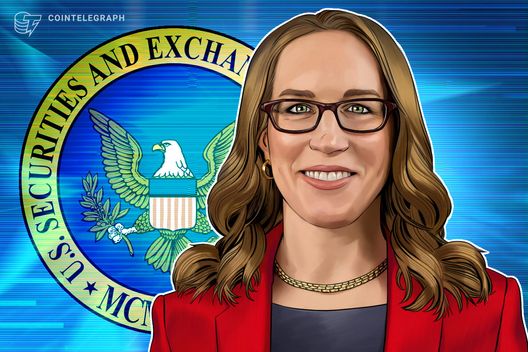
As the digital asset landscape continues its relentless march towards integration with traditional finance, the United States finds itself at a critical crossroads. Navigating this convergence requires a delicate balance between fostering innovation and safeguarding investors – a challenge that has often seen U.S. regulators lean heavily on the latter, sometimes at the expense of the former. Against this backdrop, SEC Commissioner Hester Peirce, affectionately known as ‘Crypto Mom’ within the digital assets community, has once again emerged as a pivotal voice, advocating for a more pragmatic and forward-thinking regulatory approach. Her recent call for simpler disclosure rules and the exploration of an innovation exemption for tokenized securities underscores a deep understanding of the industry’s needs and the potential pitfalls of regulatory inertia.
Commissioner Peirce’s stance is not new; she has been a consistent proponent of regulatory clarity and innovation-friendly frameworks for years. Her advocacy stands in stark contrast to the SEC’s broader enforcement-led approach, which has often been criticized for creating a ‘regulation by enforcement’ environment rather than providing clear guidelines. Peirce’s latest remarks highlight two key areas of friction: the complexity of existing corporate disclosure rules for novel digital assets and the burgeoning, yet legally ambiguous, realm of tokenized securities.
The current disclosure regime, designed primarily for mature, centralized corporate structures, often proves to be an ill-fit for the decentralized, open-source, and often nascent projects characteristic of the blockchain space. The sheer volume and specificity of information required by the SEC can be an insurmountable barrier for innovative startups, pushing them offshore or stifling their development altogether. As a Senior Crypto Analyst, I’ve observed countless promising projects struggle to reconcile their inherently transparent, real-time data with static, often outdated, disclosure requirements. Peirce’s argument for simplification is not about lowering standards of investor protection but rather about tailoring them to the unique characteristics of digital assets, ensuring that relevant information is effectively communicated without imposing undue burdens that stifle legitimate innovation.
Beyond simpler disclosure, Peirce has thrust the ‘tokenization debate’ into the spotlight. Tokenization, the process of issuing traditional assets or rights on a blockchain, represents a potentially transformative shift for capital markets. From real estate and private equity to art and intellectual property, tokenization promises enhanced liquidity, fractional ownership, reduced settlement times, and greater transparency. It blurs the lines between traditional securities and novel digital assets, creating a regulatory quagmire. Is a tokenized share of a private company merely a digital representation of an existing security, or does its blockchain native nature imbue it with new characteristics that demand a fresh regulatory lens? The debate is fierce, with proponents seeing it as the inevitable evolution of financial markets and skeptics warning of new avenues for manipulation and investor harm.
This is where Peirce’s proposal for a potential ‘innovation exemption’ truly shines. Conceptually similar to a regulatory sandbox or safe harbor, such an exemption would allow projects dealing with tokenized securities to experiment within a defined framework, under temporary, tailored regulatory relief. This approach acknowledges that regulators do not possess all the answers to emerging technologies and that learning by doing, under controlled conditions, can yield invaluable insights for future rulemaking. Jurisdictions like the UK, Singapore, and Switzerland have successfully implemented similar frameworks, attracting significant blockchain innovation by providing a pathway for experimentation without immediate full-scale regulatory compliance. For the U.S., a well-structured innovation exemption could be a game-changer, preventing regulatory arbitrage and allowing American companies to lead, rather than lag, in the development of Web3 financial infrastructure.
However, implementing such an exemption is not without its challenges. Crafting the right parameters – defining eligible assets, setting investor protection limits, ensuring transparency, and establishing clear off-ramps to full compliance – will be critical. The goal should be to create a fertile ground for innovation without compromising the foundational principles of investor protection and market integrity. It requires a proactive, collaborative effort from regulators, industry participants, and legal experts to forge a framework that is both adaptive and robust.
Commissioner Peirce’s consistent advocacy highlights a fundamental truth: the digital asset revolution is not waiting for regulators to catch up. By pushing for simpler disclosure rules and championing an innovation exemption for tokenized securities, she offers a pragmatic roadmap for the U.S. to embrace, rather than resist, this technological tidal wave. Her vision is one where regulation is an enabler, not an inhibitor, of progress. The question remains whether her colleagues and the broader regulatory apparatus will heed the call of the ‘Crypto Mom’ and steer the nation towards a future where innovation and sound regulation can truly co-exist, unlocking the immense potential of tokenized assets for the benefit of all.