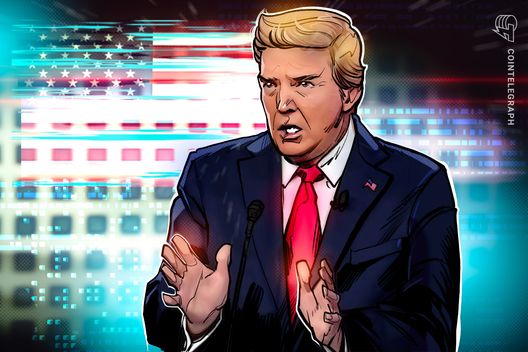
The global economic landscape has been jolted yet again by a significant policy shift from the United States. President Donald Trump’s recent announcement to levy a global tariff rate of 15%, reportedly via ‘alternative legal routes,’ has sent ripples of concern through traditional financial markets. Critics are already questioning the legal authority underpinning such a broad imposition, raising specters of trade wars, inflationary pressures, and supply chain disruptions. Yet, in a stark divergence, the crypto markets have remained remarkably unfazed, exhibiting a surprising resilience that warrants a deeper analytical dive from a senior crypto analyst’s perspective.
Historically, major macroeconomic or geopolitical shocks would typically send ‘risk-on’ assets tumbling, with investors fleeing to perceived safe havens. Cryptocurrencies, often categorized as volatile, speculative assets, might logically be expected to suffer in such an environment. However, the current situation presents a fascinating paradox: while traditional equities and commodities grapple with the implications of increased protectionism, digital assets seem to be marching to the beat of their own drum, largely immune to the unfolding trade drama.
Several factors contribute to this pronounced decoupling, fundamentally rooted in the unique architecture and evolving perception of the cryptocurrency ecosystem. Firstly, and perhaps most crucially, is the **inherently global and decentralized nature of cryptocurrencies.** Unlike traditional assets, which are bound by national borders, specific regulatory jurisdictions, and the whims of individual governments, Bitcoin and other leading digital assets operate on a distributed, permissionless ledger. A 15% tariff on goods crossing a national border is a significant impediment to traditional trade, but it holds virtually no direct sway over the peer-to-peer transfer of value across a blockchain network that transcends national boundaries.
Secondly, the **inflation hedge narrative** for cryptocurrencies, particularly Bitcoin, gains considerable traction in an environment threatened by tariffs. Tariffs are, at their core, taxes on imports, which typically lead to higher domestic prices for consumers as costs are passed on. This translates to inflation and a potential erosion of purchasing power for fiat currencies. In such a scenario, assets with a verifiable scarcity and a programmatic monetary policy, like Bitcoin’s fixed supply and predictable halving events, become increasingly attractive as a store of value. Investors, wary of fiat debasement and rising cost of living, may increasingly view Bitcoin not as a speculative gamble but as a digital form of ‘sound money’ or ‘digital gold,’ offering a refuge from inflationary pressures.
Moreover, the **maturity and self-sufficiency of the crypto market** have grown significantly. What was once a niche, retail-driven phenomenon has evolved into a robust ecosystem attracting institutional capital, sophisticated trading strategies, and a dedicated, crypto-native investor base. The introduction of spot Bitcoin ETFs in major markets, for instance, has brought unprecedented levels of institutional liquidity and mainstream accessibility. This influx of sophisticated capital, alongside ongoing technological advancements (such as Ethereum’s scaling solutions or advancements in DeFi), creates internal market momentum that can often overshadow external macroeconomic events. The market’s internal narratives – be it the Bitcoin halving cycle, specific altcoin ecosystem developments, or the growth of Web3 applications – often exert a more immediate influence than traditional economic policy shifts.
Furthermore, one could argue that **capital flight into alternative, less regulated assets** might be playing a subtle role. When traditional economic systems become subject to increased friction, political maneuvering, and regulatory uncertainty (as Trump’s ‘alternative legal routes’ suggest), capital may seek avenues that offer greater freedom and less governmental interference. Cryptocurrencies, for all their own regulatory challenges, represent a fundamentally permissionless system. This isn’t to say they are ‘unregulated,’ but rather that they offer a different kind of ‘regulatory arbitrage’ or an escape hatch for capital seeking to circumvent nationalistic economic policies.
It is crucial to acknowledge that crypto markets are not entirely decoupled from global events. A truly catastrophic global economic collapse would undoubtedly impact digital assets. However, the current resilience suggests that for specific types of macro-economic shocks – especially those related to trade policy and nationalistic protectionism – cryptocurrencies are demonstrating a distinct form of immunity. This immunity stems from their fundamental design principles: decentralization, borderlessness, and a monetary policy independent of central banks.
In conclusion, the crypto market’s unflinching stance in the face of Trump’s ambitious global tariff hike is not merely a coincidence; it is a profound testament to its evolving role in the global financial architecture. It underscores a growing recognition of digital assets as a unique, uncorrelated asset class that offers distinct advantages in an increasingly fragmented and protectionist world. As traditional economies navigate the turbulent waters of trade wars and shifting national policies, the digital asset space continues to carve out its own path, offering a potential sanctuary for value and an engine for innovation that operates beyond the reach of conventional economic levers. This decoupling is a powerful indicator of crypto’s maturation and its increasingly significant, albeit distinct, position on the global stage.