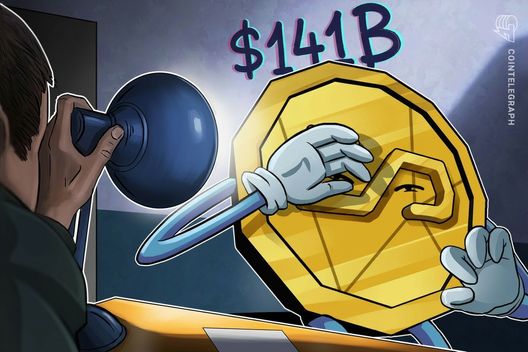
The burgeoning world of stablecoins, heralded as the bridge between traditional finance and decentralized innovation, finds itself at a critical juncture. A recent and alarming report from TRM Labs reveals that illicit stablecoin activity surged to an unprecedented $141 billion in 2025, marking a five-year high. This staggering figure, driven predominantly by sophisticated sanctions evasion networks, complex money laundering schemes, and shadowy “guarantee marketplaces,” casts a long shadow over the crypto industry’s aspirations for mainstream adoption and regulatory acceptance. As a Senior Crypto Analyst, the implications of this report are profound, underscoring urgent challenges that demand a concerted, multi-stakeholder response.
The sheer scale of $141 billion in illicit stablecoin transactions in a single year is a stark indicator of the growing sophistication and preference for digital assets among criminal enterprises and sanctioned entities. Stablecoins, designed to maintain a peg to fiat currencies like the US dollar, offer a unique combination of features attractive to bad actors: they provide the price stability lacking in more volatile cryptocurrencies, coupled with the speed, pseudo-anonymity, and borderless nature inherent to blockchain technology. This potent mix allows for rapid, global value transfer outside the purview of traditional financial intermediaries, making them an ideal conduit for activities ranging from funding illicit operations to moving black money across jurisdictions. The five-year high isn’t just a numerical milestone; it signifies a systemic entrenchment of stablecoins within the global illicit finance ecosystem, challenging the narrative of crypto as purely a force for good.
TRM Labs’ report specifically highlights three dominant categories fueling this illicit surge. Firstly, **sanctions evasion networks** have increasingly leveraged stablecoins to circumvent international economic restrictions. In an increasingly geopolitically fractured world, stablecoins provide a powerful tool for sanctioned states, entities, and individuals to access global financial markets, procure goods, and fund operations by bypassing traditional banking channels. The pseudo-anonymous nature of many stablecoin transactions, coupled with the difficulty of tracing ultimate beneficial ownership across various blockchain networks, presents significant hurdles for enforcement agencies striving to maintain the integrity of international sanctions regimes. This capability poses direct threats to national security interests and global financial stability.
Secondly, **large-scale money laundering schemes** have found stablecoins to be a highly efficient vector for obscuring the origins of illicit funds. Criminal organizations are employing sophisticated techniques, including layering transactions across multiple addresses, utilizing privacy-enhancing mixers, and exploiting cross-chain bridges, all denominated in stablecoins. The speed and irreversibility of blockchain transactions, once executed, make recovery exceptionally challenging for law enforcement, allowing vast sums to be “cleaned” and integrated into the legitimate financial system with unprecedented efficiency. Unlike traditional fiat laundering, which often relies on slower, more trackable bank transfers, stablecoins offer a digital escape route, enabling near-instantaneous global asset relocation.
Finally, the emergence of “guarantee marketplaces” as a significant vector for illicit stablecoin use introduces another layer of complexity. While the term itself suggests various interpretations, in this context, it likely refers to underground financial services where stablecoins are used as collateral or payment for illicit bonds, dark market insurance schemes, or escrow services facilitating illegal contracts. These marketplaces could be enabling everything from drug trafficking and arms dealing to illicit gambling and fraudulent activities, all underpinned by the perceived reliability and accessibility of stablecoins. This specific use case points to the development of a shadow financial infrastructure operating parallel to the regulated world.
The dramatic rise in illicit stablecoin activity can be attributed to several factors beyond their intrinsic properties. The overall growth and maturation of the stablecoin market itself have provided more liquidity and broader access, inevitably attracting a wider spectrum of users, including nefarious ones. Simultaneously, illicit actors have become more sophisticated, continuously adapting their methods to exploit evolving technological capabilities and regulatory arbitrage opportunities across different jurisdictions. Furthermore, the global nature of blockchain technology means that regulatory frameworks, which vary widely from nation to nation, struggle to keep pace, creating gaps that bad actors are quick to exploit.
This report serves as a clarion call for intensified regulatory oversight and proactive industry measures. Regulators worldwide are already grappling with how to effectively oversee stablecoins, with initiatives like the EU’s MiCA regulation and ongoing discussions in the US pointing towards greater scrutiny. The findings from TRM Labs reinforce the urgency for comprehensive Anti-Money Laundering (AML) and Know Your Customer (KYC) frameworks to be applied consistently across stablecoin issuers, exchanges, and other service providers. However, the challenge lies in striking a delicate balance: fostering responsible innovation and the legitimate utility of stablecoins for payments and remittances, while aggressively combating their misuse by criminal elements.
In conclusion, the $141 billion illicit stablecoin activity in 2025 is not merely a statistic; it’s a profound challenge to the legitimacy and future trajectory of the entire crypto ecosystem. It threatens to erode public and institutional trust, invite heavier regulatory burdens, and potentially undermine the financial integrity of nations. For the crypto industry, the path forward requires a collaborative commitment: leveraging advanced on-chain analytics tools like those pioneered by TRM Labs, actively cooperating with law enforcement, and advocating for smart, risk-based regulations that can evolve with the technology. Only through such a unified approach can we hope to harness the transformative potential of stablecoins while effectively neutralizing their darker applications. The alternative is a future where the shadow of illicit finance looms ever larger over the promise of decentralized finance.