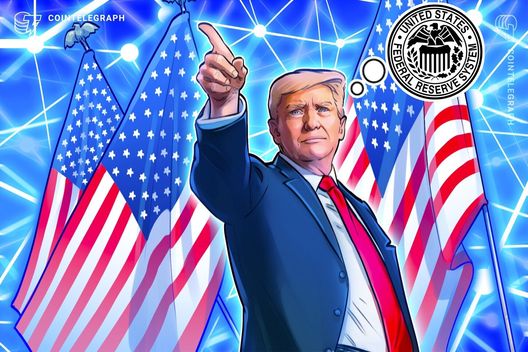
The impending nomination of Kevin Warsh as the next Federal Reserve Chair by President Trump, as suggested by recent reports, has sent ripples across financial markets. While Warsh is widely characterized as a ‘hawkish’ pick – a stance that typically sends shivers down the spine of risk-asset investors – it’s a specific, often overlooked, aspect of his past commentary that has caught the keen eye of the cryptocurrency world: his assertion that Bitcoin could serve as a ‘check on fiscal policy decisions.’ This single statement elevates what might otherwise be a traditional monetary policy debate into a profound discussion about the future role of digital assets within the global financial architecture.
Warsh’s potential ascendancy to the helm of the world’s most influential central bank presents a complex, potentially dichotomous, future for the crypto landscape. On one hand, his hawkish tendencies signal a lean towards tighter monetary policy, higher interest rates, and a stronger U.S. dollar – conditions that historically tend to exert downward pressure on speculative assets, including cryptocurrencies. On the other, his acknowledgment of Bitcoin’s utility, even if as a cautionary instrument, could imbue the nascent asset class with an unprecedented level of legitimacy from the very institutions it seeks to disrupt.
**The Hawkish Blueprint: A Traditional View**
Kevin Warsh is not a stranger to the Federal Reserve, having served as a governor from 2006 to 2011. During his tenure, he earned a reputation as a fiscal conservative, often voicing concerns about inflation and the expansion of the Fed’s balance sheet. His perspective aligns with a school of thought that prioritizes price stability and advocates for a more restrained approach to monetary intervention. A Warsh-led Fed would likely steer away from the expansive quantitative easing programs that characterized the post-2008 era, favoring a more orthodox, data-driven approach to interest rate adjustments.
For traditional markets, this implies a potential shift towards a higher interest rate environment, which could strengthen the dollar, increase borrowing costs, and introduce volatility into equity and bond markets. Such an environment generally prompts investors to re-evaluate their risk exposures, often leading to a rotation out of riskier assets. This macro backdrop, purely from a hawkish perspective, might be seen as a headwind for the inherently volatile cryptocurrency market.
**Bitcoin as a ‘Check’: A Paradigm Shift in Central Bank Thinking**
The true intrigue for the crypto community, however, lies in Warsh’s past remarks about Bitcoin. To state that Bitcoin could act as a ‘check on fiscal policy’ is a profoundly significant observation for a figure of his stature. What does this mean in practical and philosophical terms?
At its core, Bitcoin was created as a response to the perceived failures and excesses of the traditional financial system, particularly sovereign central banking and government fiscal policies. Its fixed supply cap of 21 million coins and decentralized nature inherently limit the ability of any single entity to debase its value through inflationary money printing or unchecked government spending. When Warsh speaks of Bitcoin as a ‘check,’ he is implicitly acknowledging this fundamental premise: that an immutable, non-sovereign digital asset can serve as a de facto monitor or even a competitive alternative to the discretionary decisions of national treasuries and central banks.
This perspective represents a radical departure from the skepticism, dismissal, or outright hostility often exhibited by traditional financial authorities towards Bitcoin. Instead of viewing it as a fringe experiment or a tool for illicit activities, Warsh appears to recognize its potential role as a market-driven barometer for fiscal prudence. In an era of escalating national debts and unprecedented government spending, the idea that an external, apolitical force like Bitcoin could exert pressure on policymakers to be more fiscally responsible is a powerful one. It speaks to the sound money principles that many in the crypto space champion, and it hints at a deeper understanding of Bitcoin’s value proposition beyond mere speculative trading.
**Implications for the Cryptocurrency Market**
Warsh’s potential nomination, therefore, sets up a fascinating dynamic for the crypto market:
1. **Increased Legitimacy:** For a prospective Fed Chair to acknowledge Bitcoin’s role, even a critical one, is a massive step towards mainstream validation. It signals that Bitcoin is no longer just a niche investment but a subject worthy of high-level economic discourse. This could attract further institutional interest and investment, viewing Bitcoin not just as a speculative gamble but as a legitimate hedge against fiscal irresponsibility.
2. **Regulatory Nuance:** While Warsh’s acknowledgment of Bitcoin’s utility doesn’t automatically imply favorable regulation, it could lead to a more measured and perhaps less punitive approach. If Bitcoin is seen as serving a vital function – even a critical one – policymakers might focus on establishing regulatory frameworks that ensure stability and consumer protection rather than outright suppression.
3. **Macro vs. Philosophy:** The immediate macro environment under a hawkish Warsh Fed might indeed create headwinds for crypto prices in the short term, as a stronger dollar and higher interest rates typically dampen enthusiasm for risk assets. However, the long-term philosophical implications of a Fed Chair who understands Bitcoin’s ‘check’ mechanism could be profoundly bullish. It could reinforce Bitcoin’s narrative as digital gold and a store of value in an increasingly uncertain global economic landscape.
In conclusion, the prospect of Kevin Warsh leading the Federal Reserve presents a complex and intriguing scenario for the cryptocurrency world. While his hawkish stance on monetary policy could bring near-term challenges, his uniquely candid perspective on Bitcoin’s role as a ‘check on fiscal policy’ could, paradoxically, be one of the most significant developments for legitimizing and integrating digital assets into the broader financial dialogue. Crypto investors and enthusiasts will be watching closely, not just for interest rate hikes, but for how this unprecedented blend of traditional central banking and blockchain philosophy will unfold.